Song Publisher Looking For Songs: PEN Music Group
Posted: January 9, 2015 Filed under: Song Pitch Opportunity | Tags: Pen Music Group, Publishers looking for songs Leave a commentIf you write:
electronic, folk, country, pop or rock this may be an opportunity.
Based in Los Angeles, PEN primarily focuses on placing songs in movies and network television, these, for example are a few of their many successes:
Dancing With The Stars (ABC)
Criminal Minds (CBS)
The Strain (FX)
The Mindy Project (FOX)
Currently looking for material, however they periodically restrict submissions depending on their work load.
Be sure to request permission before submitting material. Both the songwriting and recording should be professional demo quality.
Contact info:
PEN Music Group, Inc.
Michael Eames, President
Phone: 818-766-9200
Christian Indie Group Experiences Success With Over-The-Internet Album Collaboration
Posted: October 19, 2014 Filed under: Christian, Now Tracking | Tags: Christian, Gospel, nashville trax, Over The Internet, The Greatest Gift Leave a comment
A Christian vocal trio known as The Greatest Gift decided to do an album of material penned by bandleader Wayne Paterson. Unhappy with previous efforts recorded at studios located in Nashville, New York and Los Angeles he searched for a new studio that could bring the magic he knew existed to his work.
He began sending piano/vocal demos to producer Bill Watson of Nashville Trax in March of 2015 and was ecstatic with the results. With Watson arranging and producing the music tracks, then sending them to The Greatest Gift where they add vocals and mix at a local studio, they have finished the first album, Come Into His Presence, and have nearly completed a second.
The Greatest Gift is also using the mixed and mastered tracks to perform live and even sing to the tracks in Christian songwriting and performance contests. They took first place in the local, regional and state competitions and are scheduled to compete in the national finals in Tennessee this coming spring.
The Greatest Gift is reporting brisk sales at churches and other live concert performances, helping them recoup their investment plus help fund the next CD. They’ve also been able to secure an entertainment lawyer based in Nashville to help them pursue national distribution.
Give a listen:
Nashville Studio Full Band Demo Price
Posted: August 4, 2014 Filed under: Uncategorized Leave a commentHow much should you pay for a full band demo using Nashville session quality players?
Every studio will have it’s own pricing and overhead but this will give you a reasonable guideline,
Session musicians charge studios $50 to $75 per song for a demo session. Singers charge $80 and up. $125 is average but some charge much more.
Some musicians can play two instruments at session quality and may do a second pass at a discount.
There is also a studio rate which may or may not include the producer and engineer.
The typical full band demo will involve 1 day of work for the studio and production team. At $50 per hour that’s $400.
Five musicians at $60 each is $300. A singer for $125. Grand Total for a 5 piece demo: $825.– b.e. watson
“But For One Day” Mix Completed. Hear Jen Knock It Out Of The Park!
Posted: July 8, 2014 Filed under: Now Tracking | Tags: But For One Day, Sax, Songwriter Vince Taylor, Soul Singer Jennifer L Leave a commentVince Taylor wrote this as a straight ahead, white bread piano ballad so turning it into a soulful Memphis tune with sax was risky but I really felt it needed to go in that direction and the more I listened to the rough, the more I was convinced Joplin-channeling soul singer, Jennifer L, should sing it.
Here’s a clip of But For One Day:
Hopefully the result speaks for itself?- b.e. watson
Update: 10-15-14 Vince contacted us via e-mail to report this recording has passed muster with a radio program director he submitted it to and, with Jennifer’s blessing, is currently receiving airplay.

Why not have our Nashville session singer Jennifer sing your song?
But For One Day is © 2014 Vince Taylor. All rights reserved, provided here a a demonstration of production values only, all other uses prohibited under U.S. and International copyright law. If you’d like to record or perform this work, please e-mail us and your request will be forwarded to the songwriter and/or publisher.
Aaron McDaris Banjo Tracks Online! Get Banjo Tracks Over The Internet!
Posted: July 6, 2014 Filed under: Nashville Session Musicians | Tags: Aaron McDaris Rhonda Vincent, Aaron McDerris Banjo Tracks Online, Banjo Tracks Over The Internet Leave a commentIf you need a banjo track to add to your music project, why go anywhere other than Nashville Trax? You can have the best session banjo player on the planet play your track using the historic Rocky Top banjo!
Here’s the link to order your track as well as the story about both Aaron and the piece of American history he plays:
Aaron plays live for Rhonda Vincent, he plays with the staff band on the Opry and The American Banjo company developed and sells the Aaron McDaris signature model. Rock solid, even, intricate banjo playing is what Aaron is all about. Ned banjo? He’s the real deal!

Aaron displaying the very banjo Sonny Osbourne played on the recording of Rocky Top in 1967!

Aaron will play his historic “Rocky Top” banjo on your song!
Breaking News: Mix Finished on Midnight, Me and the Moon, Client Thrilled!
Posted: July 1, 2014 Filed under: Now Tracking | Tags: Bill Watson bass guitar, Greg Jennings (Guitars), Jenee Fleenor (Fiddle), Midnight, Mike Douchette (Harmonica), Ron Fairchild (Piano), song project, Wayne Lewis, William Ellis (Drums) Leave a commentMidnight, Me And The Moon, the first of a five song project is finished:
B4 and after. Here’s the “client version” clip, the version Wayne submitted as his rough. It perfectly mapped the direction he envisioned:
Our job was to employ our considerable experience and available talent to bring Wayne’s idea to fruition. Our Version:
Judging by his glowing e-mail, client Wayne Lewis of Alaska is thrilled:
To
Bill Watson, Nashville Trax
Today at 12:47 PM
“GREAT Job, Bill!!!! I agree with you…it works perfectly well with a female vocal. Good call! Everybody did a terrific job. Please thank Jenn especially, she gave it a wonderful ride! Wayne”
Musicians:
Greg Jennings (Guitars)
William Ellis (Drums)
Ron Fairchild (Piano)
Jenee Fleenor (Fiddle)
Mike Douchette (Harmonica)
Bill Watson (Bass Guitar)
Wayne’s songs two through four will feature male vocalists are in various stages of production with two mixes expected to be finished toward the end of next week.
“Wayne felt we should record this with a vocalist that sounds like Dwight Yoakum. I liked his idea of giving the recording a bit of rockabilly vibe and making it sound almost like the listener is hearing a live band but the more I worked with it in pre-production the more I could hear a powerhouse country female vocal, so I went with my instincts without letting Wayne know. Jennifer just flat out delivered an excellent performance that made the concept work. I didn’t realize at the time this would be the first song of the five I’d finish so it was nail biting time when I sent Wayne the mix. Hey, the tune rocks, Wayne loves it, ALL GOOD!” – Bill Watson, producer

Here’s Jennifer just prior to tracking her vocal on Midnight, Me and the Moon!
Midnight, Me and the Moon © 2014 by Wayne Lewis is for demonstration of production values only. Any other use is a violation of U.S. and International copyright law. Requests to record this song will be forwarded to the songwriter and/or publisher.

Why not let Jenn sing YOUR song?
Female Studio Singer Online for Country, Rock, Pop, Blues…
Posted: June 12, 2014 Filed under: Studio Services | Tags: blues, country, Female Studio Singer Online, Pop, rock Leave a comment
Country, pop, rock and blues singer Jennifer
Are you in need of a female studio singer online? Our singers WILL deliver high quality lead and harmony vocals on .wav files delivered over the Internet. The tracks will drop right in and automatically line up with the music tracks you recorded.
How? Everything you need to know is right here at Female Studio Singer Online Vocal Tracks

Jenee can sing your country or blugrass delivered over the Internet!
Review: Waves Bass Rider Plug In Software For Pro Tools HD
Posted: June 9, 2014 Filed under: Pro Tools Software | Tags: complimentary motion, compressor, Waves Bass Rider Plug In Leave a comment
Waves Bass Rider
The first thing to know about the Waves Bass Rider Plug In is: it’s not a compressor. A compressor controls levels by squashing and coloring the sound of the instrument or vocal being compressed. It’s not usually a huge coloration but it definitely changes the tone. The rider works like an engineer riding the fader. Bass Rider reads the incoming mix signal and adjusts accordingly.
There are maximums and minimums to the fader travel to set, which you can do by ear. The more even the original bass playing was, the better, but the Rider will adjust a pretty wide range of variation in the original levels. As a matter of reference, here’s what pro bass guitar sounds like.
But what if you want some complimentary motion in your mix? What if you want the drums up slightly, bass down in the verse but reversed in the chorus? In Pro Tools simply create two duplicate tracks with the Rider Plug In on each and set one overall volume up, one down and mute the sections according to what you want.
Note that you can still use a compressor if you like. I recommend inserting the compressor, your EQ plug, Max Bass and whatever else you use, after the Bass Rider. While it’s fairly common for most engineers to compress bass guitar automatically, with the Rider you may not find it necessary on some songs.
Often while producing your projects you’ll need a vocalist that suits your song. It would be wise to bookmark this page of session quality singers available online. One may be perfect for your next project!
The Waves Bass Rider isn’t the cure for everything, once again, great tone and even-in-volume playing, as well as tightness all contribute to how the bass guitar will work in your mix. But the Bass Rider is absolutely a must-have you should have in your plug in tool box- b.e. watson
Songwriting Tips On Avoiding Three Huge Amateur Format Mistakes
Posted: June 8, 2014 Filed under: Uncategorized | Tags: excessive use of diamonds, pushfest anyone?, Useless bars, Why re those bars even there? Leave a comment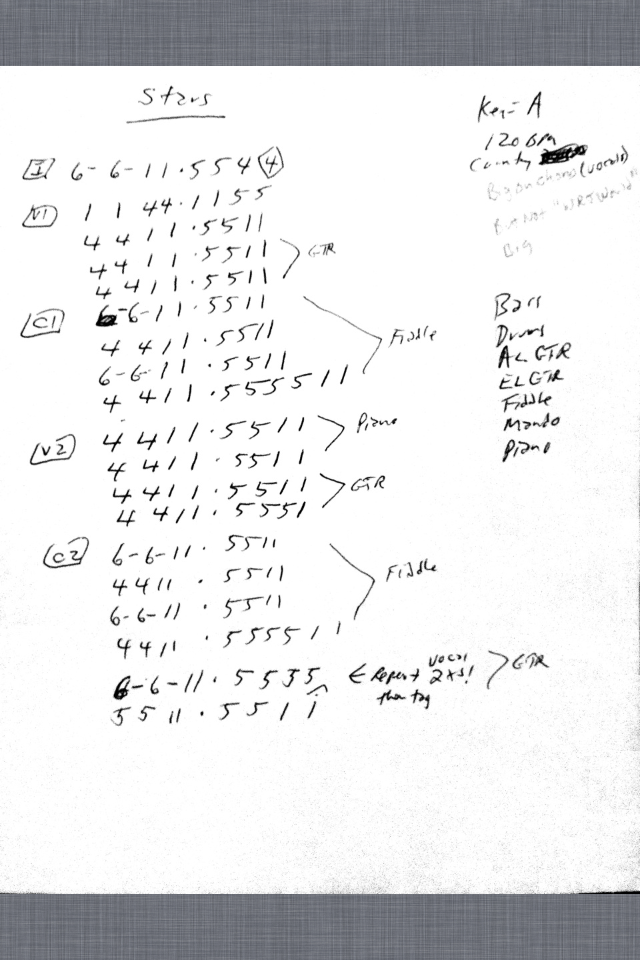
A Bad Chart Is Almost As Bad As No Chart At All!
Wow! where do I start?
I received a Tracks Online Project yesterday. It was sent in by another producer who wanted us to add fiddle and steel guitar to it, probably because the area of the U.S. he worked in didn’t have any world class players on those instruments. Or on any instruments judging by the recording. But the biggest problem I noticed, and the fiddle player did too, was four bars of the root chord just prior to where a fiddle solo came in.
The bars were useless to the song. They added nothing. Worse, if we left them blank there was nothing happening which means: boring!. If we put a little fiddle in there it sounded like solo and detracted from the impact of the fiddle entering at the real solo point. The fiddle player and I looked at each other dumbfounded…knowing exactly what the other was thinking: “Why are those bars even there?”
Sometimes extra bars are indeed necessary. Maybe you end a chorus and need a tonic chord for a couple of bars so the singer ends on a note compatible with the root key or maybe to separate the verse so the chorus singing doesn’t overlap.
But songwriters have a tendency to place useless bars after verses, after choruses, in intros and other places where taking them out would benefit, not hurt. Other “too many bars” situations may include introductions that are longer than necessary and “turns” that are double the length they should be. Typically this “turnaround” would be four bars long. Eight bars is usually to long and it starts to feel more like the main solo area of the tune. Try it both ways and if the shorter solo or turn feels better, go with it. Nothing is gained from weirdness or boring your audience.
Analyze your song for unnecessary bars and eliminate them.
Excessive use of stops and diamonds is a second pitfall best avoided (a diamond is when you play a chord on the first beat of a measure then simply let it ring through the next three beats). Diamonds can sound cool in the right spot but overuse starts to give the whole song a disconnected vibe. Ditto stops where the band stops on the initial downbeat then comes back in after four or eight beats. They are great tools that can add interest, just don’t overuse them to the point your song sounds strange and disjointed.
A third sign of an amateur is over use of pushes. A push is when the band plays a chord on the upbeat before the downbeat where it would normally occur. Tap your foot as you play and see if some chord changes are happening when your foot is up instead of down. That’s a push that would be noted on a chart with a check mark above the pushed chord. Pushes can work well at times but Adele’s “Hello” aside. you don’t usually want to turn your song into a pushfest!
All that being said all these points aren’t set in stone and I could cite examples of hits that ignore these “rules”. It’s a song-by song thing. What sounds downright weird in one song and needs to be fixed might work well in another. – b.e. watson
The Man In The Distance Mix Finished!
Posted: May 21, 2014 Filed under: Now Tracking | Tags: Bill Watson Nashville Music Producer, Fiddle, Jenee Fleenor, Kevin Wood, Los Angeles, Man In The Distance, The Voice Leave a comment
Play It Again Demos Music Producer, Bill Watson
Jenee finally returned from Los Angeles where she’s been “working” on The Voice (getting pampered/living it up on the production company’s dime, LOL) long enough to get some real work done: utilizing her amazing talents to get a few fiddle, mandolin and vocal tracks locked down. One was the final track needed to mix this awesome little ballad, Man In The Distance, written by songwriter Kevin Wood:
Here’s a clip of the client “Before” Version starting in verse two:
Our “after” Version, same spot:
Kevin did a great job laying out his vision. A lot of changes were made though, there was some superfluous stuff. And the song clocked in at about 5 minutes, way too long in a world where “radio friendly” is about 2 to 3 minutes.
“The “howling wolves” vocal sounds Kevin had were interesting but were deleted in the charting phase. Several bars of music that served no purpose were axed. Also, Kevin put a tag on every chorus which wasn’t appropriate (a “tag” is when you repeat the last line of a section, usually verbatim. in this case with different words but it still made the whole chorus feel too lengthy) I kept only the final tag.
A little tightening, and there you have it, a song I think has a great chance of garnering a publishing contract!
Which version would you take to the pitching table?
After hearing the mix, Kevin said, “Wow — Nice!! You guys did a great job, and you are very skilled at what you do, brother!”
Man In The Distance is © 2014 Kevin Wood, posted by permission.
If you’re interested in recording this song, using it in a commercial application or singing it in a performing situation please let us know and we’ll forward your request to the songwriter and/or the music publisher.
The Crows Run Band Story, The Early Days: John Roebuck, Bill Watson, Nudist Colonies and Rock & Roll
Posted: May 10, 2014 Filed under: Session Player Stories | Tags: Bill Watson, Billy Elroy Band, Crow's Run Band, Crows Run, Don Plum, Forrest Stolz, Jimi Miller, Joe Patrick, John Roebuck, Julie Peterson, Mike Thellman, Paul Dennis, Sidewinder Leave a comment
One of the first Crows Run Band gigs. left to right: Bill Watson (guitar/vocals) Joe Patrick (bass) Bob Jay (drums) John Roebuck (guitar/vocals)
Crows’ Run Band, began performing with four pieces in the Pittsburgh, PA area during the 1970’s. The group typically played five to seven nights each week, but after only 15 months into Bill Watson’s first stint as lead guitarist with the group, and with plenty of work on the schedule, they disbanded for a period due to personal reasons.
A few years later guitarist/singer, John Roebuck, reformed CRB in a three piece drums, guitar and bass guitar configuration that eventually saw Bill Watson return playing bass rather than lead guitar. Watson, who now produces music and plays on sessions for his Nashville, Tennessee based music recording business, Nashville Trax, soon began alternating between guitar and bass with lead singer/guitarist John Roebuck. Watson, predominately on bass, would sing 3 or 4 songs per set, switching briefly from bass to play guitar while singing.
CRB achieved a degree of local notoriety during the 1980’s. With Paul Dennis in the drum chair, they won a local band contest in spite of competing against bands as large as six pieces. They also released
One of the first Crows Run Band gigs. left to right: Bill Watson (guitar/vocals) Joe Patrick (bass) Bob Jay (drums) John Roebuck (guitar/vocals)
Crows’ Run Band, began performing with four pieces in the Pittsburgh, PA area during the 1970’s. The group typically played five to seven nights each week, but after only 15 months into Bill Watson’s first stint as lead guitarist with the group, and with plenty of work on the schedule, they disbanded for a period due to personal reasons.
A few years later guitarist/singer, John Roebuck, reformed CRB in a three piece drums, guitar and bass guitar configuration that eventually saw Bill Watson return playing bass rather than lead guitar. Watson, who now produces music and plays on sessions for his Nashville, Tennessee based music recording business, Nashville Trax, soon began alternating between guitar and bass with lead singer/guitarist John Roebuck. Watson, predominately on bass, would sing 3 or 4 songs per set, switching briefly from bass to play guitar while singing.
CRB achieved a degree of local notoriety during the 1980’s. With Paul Dennis in the drum chair, they won a local band contest in spite of competing against bands as large as six pieces. They also released Watson’s first producing effort, a cassette album mix of originals and cover songs that garnered some local attention and airplay. After five years with that configuration, Watson left the group, forming The Billy Elroy Band with Watson on lead vocals and guitar, Don Plum on bass guitar and vocals and “Stitz” (Forrest Stolz) on drums. The Billy Elroy Band went on to moderate success, working steadily for four years, developing a sound that featured intricate vocal harmony, but it was without Plum, who dropped out early, replaced by Butch Curry on bass and harmony vocals. Plum wouldn’t work with Watson again until the band Sidewinder was formed by Watson and drummer, Jimi Miller, in the early 90’s.
In 1991 Bill Watson returned to The Crows’ Run band for the third and final time with Watson on bass guitar and the talented Mike Thellman playing drums, creating a thunderous rhythm section to complement John Roebuck’s powerful vocals and unique guitar playing. the band recorded a single Watson wrote, “Turn Up he Radio.” But after a little over a year into the third go-round of performing repeatedly in small bars, clubs and the local nudist colony, Watson, desiring via his songwriting/producing/management efforts to focus on propelling CRB to a higher level, discovered not everyone was on that page with him and lost interest.
Eventually Watson and Roebuck parted ways, opening the space for Watson and drummer Jimi Miller to form the highly successful and exciting five piece concert band, Sidewinder, with Julie Peterson on bass/vocals, radio celebrity Jimi Miller on drums, Watson’s girlfriend (later his wife) Rhonda Watson, a recording artist in her own right, who would later tour overseas, on keyboards and lead vocals.
Sidewinder was high energy, modern country, served up concert style, just as country rock was replacing traditional country music on radio stations.
Don Plum initially joined Sidewinder on acoustic guitar, but later took Peterson’s spot on bass.
Watson and Plum both continued with Sidewinder, riding the wave of success through various configurations, one with Watson’s cousin David Watson. on drums, until Bill Watson moved permanently to Nashville in 2004 to pursue music producing.
Both The Crows’ Run Band and Sidewinder are still intact and performing in clubs in the Western Pennsylvania and Eastern Ohio area.
a cassette album mix of originals and cover songs that garnered some local attention and airplay. After five years with that configuration, Watson left the group, forming The Billy Elroy Band with Watson on lead vocals and guitar, Don Plum on bass guitar and vocals and “Stitz” (Forrest Stolz) on drums. The Billy Elroy Band went on to moderate success, working steadily for four years, developing a sound that featured intricate vocal harmony, but it was without Plum, who dropped out early, replaced by Butch Curry on bass and harmony vocals. Plum wouldn’t work with Watson again until the band Sidewinder was formed by Watson and drummer, Jimi Miller, in the early 90’s.
In 1991 Bill Watson returned to The Crows’ Run band for the third and final time with Watson on bass guitar and the talented Mike Thellman playing drums, creating a thunderous rhythm section to complement John Roebuck’s powerful vocals and unique guitar playing. But after only a little over a year into the third go-round of performing repeatedly in small bars, clubs and the local nudist colony, Watson, desiring via his songwriting/producing/management efforts to focus on propelling CRB to a level beyond the small bar scene, discovered not everyone was on that page with him and lost interest.
Eventually Watson and Roebuck parted ways, opening the space for Watson and drummer Jimi Miller to form the highly successful and exciting five piece concert band, Sidewinder, with Julie Peterson on bass/vocals, radio celebrity Jimi Miller on drums, Watson’s girlfriend (later his wife) Rhonda Watson, a recording artist in her own right, who would later tour overseas, on keyboards and lead vocals.
Sidewinder was high energy, modern country, served up concert style, just as country rock was replacing traditional country music on radio stations.
Don Plum initially joined Sidewinder on acoustic guitar, but later took Peterson’s spot on bass.
Watson and Plum both continued with Sidewinder, riding the wave of success through various configurations, one with Watson’s cousin David Watson. on drums, until Bill Watson moved permanently to Nashville in 2004 to pursue music producing.
Both The Crows’ Run Band and Sidewinder are still intact and performing in clubs in the Western Pennsylvania and Eastern Ohio area.
 A Songwriting & Recording Blog