Vocal Tracks Online Service: Hire a Nashville demo singer for your song production!
Posted: April 14, 2014 Filed under: Client News, Music Industry News, Studio Services | Tags: female country singer tracks online, female singers online, JenniferL Nashville Session Singer, male singers online, Nashville session singer, nashville trax recording studio, singers over the Internet, Vocal Tracks Online Leave a comment
Why not have Nashville session demo singer, Jennifer L, sing your song?
Take a quick look at the choices available at Vocal Tracks Online!
06-12-14 For Immediate Release:
Nashville Trax Launches Vocal Tracks Online!
Many self-producers and sometimes even experienced studio owner/producers don’t have the right singer available for a particular song. Vocal Tracks Online solves that problem by offering the client proven Nashville session singers over the Internet who can be added to their work by trading files online that lock right up to their project. It’s easy and it’s smart business!
The producer doesn’t have to “search and hope” by running Craigslist ads and other dubious singer search methods. They can get proven, reliable talent with great pitch and tremendous skills to make their singing choice a “sure thing” instead of an expensive shot in the dark.
Here’s one of our male vocalists, Jason, on a country ballad:
We have both male singers online and female singers online in almost any style a producer needs. If a producer needs a Jo Dee Messina style powerhouse modern country singer, they can Google “female country singer tracks online” and dial right into our site.
Pricing is reasonable and varies according to the singer’s experience; demand for their services; whether or not they do major label work and other factors.
Bass Guitar Tracks Online, Over The Internet Bass Tracks
Posted: April 10, 2014 Filed under: Now Tracking, Studio Services, Tracks Online | Tags: Ampeg SVT, Bass Guitar Tracks Online, Bass guitar tracks over the Internet, ender Precision Bass, Steve Whitaker Leave a commentBass guitar tracks online is our service that permits a person producing their own project at home or in a local studio to add a pro played bass guitar track to their production. Yes, it’s worth it, yes, it makes a big difference.
An order just in for our Bass Tracks Online service from Steve Whitaker who is having Nashville Trax record the first bass guitar track for a rock album cut. He’d already ordered the same track part from another service but was not happy with it, even after a modification.
Part of the problem was the playing itself, part was the track was “bottoming out” badly on the low notes. If we can make him happy, we’re in for all the bass tracks on the project.
Steve Whitaker 🙂
After receiving the two files (one with the bass track through an Ampeg SVT, the amplifier he requested be used, and one bass track of the same part except direct line, he asked for one note to be changed in the pre-chorus section. A one note fix and he’s ready to proceed with finishing his song only now he has a fantastic sounding bass guitar track as the foundation.
Then this, after the fix: ”
Great! Thank you for getting it did. 🙂
Should have a couple more songs ready for you soon.”
Steve
Update #2: This after the bass guitar track for a second song was completed over the Internet:
Track sounds great!! Thanks again. I’m on vacation for a month after this week and will be sending you as many as I can as fast as I can 🙂
Update 3 5-14-14: We have now almost completed ten bass guitar tracks, almost finished with Steve’s entire album!
“Got the bass tracks this morning and imported into PT.
They sound great, as always!!!”
Need professional sounding bass guitar tracks for an album over the Internet played by a professional session bass player? We do that! It’s this easy!.
The final product, Steve Whitaker’s album Edge of Oblivion, featuring Nashville Trax bass guitar parts on all songs, has been released!
Home Music Production Tips: Arranging Your Song And Choosing The Right Musicians
Posted: April 2, 2014 Filed under: Home Music Production, Studio Services | Tags: Bill Watson, Fiddle, Harmonica or Pedal Steel Online, Home Music Production, Home Recording, Mandolin or Violin Online, nashville trax recording studio, Saxophone Online, Vocal Tracks Online Over The Internet Leave a comment
David Northrup Nashville Session Drummer, Click Here!
Want pro sounding, radio friendly productions? Tip #1: Use great players like David. Need more? Try these:
Fiddle, Mandolin or Violin Online
Music Production Tip:
How To Arrange Your Song and Choose the Right Musicians
Although I now produce music for Nashville Trax I started out years ago with a little 4 track cassette machine doing home recordings. I can relate to all the problems you’re experiencing in attempting to achieve a professional sound.
One area you’re almost certainly falling short in is musicianship.Back in the day I programmed a drum machine, played bass guitar, then added a couple guitar tracks, then played keyboards, sang, added background vocals and voila, a one man band!
It didn’t sound bad, in fact it was usually very good. I was a decent player, session quality on bass, and understood drumming to a degree. But there was no way I could play some of those instruments as well as a dedicated studio player who had focused on that one instrument for years, every day, eight to twelve hours a day.
No way could I, a hack keyboard player at best, get a sound out of a $500 keyboard that equaled the tone of a pro player’s $5,000 keyboard, let alone play it near as well. No way could me playing bass to a drum machine match up with a rhythm track created by a session quality live drummer and bassist. Drum machines or drum loops will never deliver the feel and expression of a live drummer playing a custom track on your song.
There are plenty of articles out there about how to mix, how to use EQ, etc. all saying “this is what you do to achieve a great sound”. but if you don’t have groove, pocket, pitch and the basic musical elements, you’ll tweak those knobs until ten days after the world explodes and never get that pro mix you’re looking for. Here’s my tip: Start with pro musicians. If you play, play your best instrument and hire the rest.
Not only will you have trouble making your $500 bass match up to the tone of a $5,000 professional grade instrument, unless you focus on bass guitar to the exclusion of almost everything else in your life, you’ll likely come up short on the performance: the tightness, the note selection, the groove! You most likely can’t and won’t deliver the definitive performance the song you labored over deserves.
If $350 microphones through a $500 preamp typical of the gear used in a home recording sounded as good as a $10,000 microphone through a $2.200 Avalon into $10,000 of software in a vocal chain, no one would buy a $10,000 mic or Avalon or expensive software. But they do. Think about it.
This shouldn’t discourage you, this should encourage you: Just like great quarterbacks don’t play defensive tackle, few people are a one man band and when you get to the “big leagues” of music, almost everyone is a specialist.
What I learned when I moved to Nashville is that live playing and session work are two very different animals; some people are born with a rare talent to play perfectly in pocket, all the time, every time. Many great live players who are good enough to play for major recording artists are not session quality players. So if you’re doing everything yourself, or using your live band’s local drummer to play on your tracks, it may be fun, it may sound “pretty good”, but it probably won’t give you a truly pro recording.
I do understand you want to produce your project at home or you wouldn’t be reading this post, you’d be reading the one that explains why the smartest thing may be to let me produce your track start to finish. You probably want to play on it, and I know you want your hands on the buttons. But strong caution: if you want a pro sound, if you want to truly compete with demos where specialists are involved in every step and hundreds of thousands of dollars of equipment are used, choose your best instrument or two and hire session quality players for the remainder. These days you can do that right over the Internet. Need a session quality drummer? Simply click here.
In fact, the rhythm section is a huge factor in determining how pro a recording will sound. If you play guitar and/or keys then I think you’d be wise to order a session quality drum and bass guitar track, then use that firm foundation to build on. Even better, hire out a basic rhythm section of rhythm guitar, drums and bass guitar, then build your project on that, adding acoustic guitar, keys, lead guitar and other instruments.
And if your song needs other instruments, they’re easy to add also!
Fiddle, Mandolin or Violin Online
Perhaps the biggest decision you’ll make on any song as a producer is choosing the right singer. In my opinion, the singer IS the song! You need a great one to put your song across. You know as well as I do that while you might “sing great” you aren’t the right choice for everything!
Keep this link in your back pocket: Vocal Tracks Online It may bail you out the next time you are trying to record a tune and know you don’t have quite the right singer available.
So back to my roots: after the 4 track it was 8 track reel-to-reel, then 16 track then 8 track digital, then two 8 track digital units midi’d as master/slave, then 16, then two 16 track digitals midi’d to make 32 tracks, a real 32 track digital machine and finally, the king daddy: Pro Tools HD. As I progressed through every configuration known to man, lol, I kept thinking, “Okay, so if I just had more tracks, then I could make this sound like the recordings they play on the radio.”
Guess what? Even with unlimited tracks and a state-of-the-art recording platform I still came up short. It’s probably not more tracks you need. In fact, it’s not any one thing, it’s almost everything! It’s skill, experience, musicianship, outboard gear, microphones, the rooms you record in, your mixing skills, your tracking skills, your experience with arranging, your musical knowledge, microphone placement…man, I could go on for days…okay, minutes at least, lol.
So if I could go back and talk to myself at the 4 track stage I’d tell myself what I’m going to tell you now: “Instead of chasing gear, learn to use what you have better, continually improve your skills at what you have a natural talent for, figure out what you do best, and interface with others who can fill in your weak areas.”
For most home producers, their greatest weakness, their biggest downfall, is mixing. They don’t have the experience, the room, the gear, the expertise, training or more importantly, the ears, to mix at a pro level. So even if you choose to do the one man band thing or hire local live quality musicians, you might want to consider hitting this link for your mix.
As far as arranging a song, the first hurdle is to be sure the songwriting is sound. If your chorus sounds almost indistinguishable from your verses you need to do some rewriting. Arrangement can certainly enhance chorus/verse separation but it shouldn’t have to carry the ball by itself! I may introduce a new instrument at the chorus but I want the note values in the melody or the number of bars on each chord…something inherent in the song structure, to change! If you play the song on acoustic guitar do listeners know when you hit the chorus?
Another good arranging tip: Cover the entire musical spectrum somewhat evenly. How even can vary song-to-song but if you have a ton of guitar tracks and other mid-range stuff, consider helping the cymbals out with a high pitched keyboard pat or a mandolin EQ’d to favor the high end, etc. panned to a different space in the mix than where you’re placing the cymbals. Typically the overheads are panned hard right and hard left so maybe place your mando at 2 o’ clock….experiment to see where it sounds best!
You also have to be very careful there aren’t any “dogfights” going on. That’s where the guitarist and the bass and the sax player are all trying to fill the same spot or worse, playing on top of the vocal. For the most part melodic fills should be played only in between vocal phrases and by only one instrument, unless two instruments are doubling the same part or playing in harmony.
So hopefully some of this helps you achieve higher quality recordings. I’d love to give you more but this post got long in the tooth quite a while ago. Thanks for hanging in and I look forward to giving you additional home producing tips in upcoming posts.- bill watson
How to Produce a Great Bass Guitar Sound for Recording
Posted: March 13, 2014 Filed under: Home Music Production, Studio Services | Tags: Avalon preamp, Bass Guitar Tracks Online, Hartke bass amp, Johnson Bass J-Station, Max Bass, Waves Bass Rider Plug In Leave a comment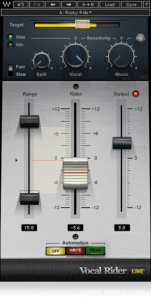
Waves Bass Rider looks and ats identical to the vocal rider, it just operates at a different frequency.
Don’t make the mistake of thinking that if you play guitar, you “can throw a bass part on too, after all it’s only bass, right?” Wrong!The bass guitar track is the most critical part of a recording.
One quick and easy way to get a fantastic sounding bass track is to try this secret. It will give you great tone and an excellent performance without spending thousands of dollars to do it.
Another way is to use a high quality instrument and put your bass through processing before it gets to the mixing board. While plugging in to the board direct gives passable results, and for a few tunes might even be the best choice, it will never have the huge, robust bass sound featured on most major label recordings.
Bass players here at Nashville Trax use a variety of rigs but common to most Nashville session players is a quality bass guitar costing in the $1,000 and up range. Second, all bass players here use some sort of Avalon preamp before the signal is inputted to the XLR that routes to the mixing board. The 737 works well, but the Avalon U5 is THE bass preamp almost every session player has in their rig.
When I play bass on a session I feed my Fender Precision or Washburn bass signal into the Avalon pre-amp. Sometimes I’ll use the compression built into the Avalon and sometimes I’ll use an outboard compressor. This provides the nice deep, tight, round tone needed and many songs and achieved by all session players. Often I’ll run a dual line through a bass guitar amp and put on a microphone on that so I’m recording two signals at once (of the same same part). This gives tone options at mixdown.
After recording there is software made specifically for bass that I commonly employ during the mixing phase. The Waves”bass rider” plug in (see photo above) acting like an automatic fader rider, helps even out any volume fluctuations without further compressing the signal. Max Bass generates super deep bass signals not present in the bass itself that can be added as desired to the original bass signal to create a solid bass tone. EQ and additional compression are typically used, but note that if you’re happy with what you’re hearing and it’s working with the other instruments and supports the song, you may not need all these plugs.
So should you play bass parts yourself? If you are really a bass player, not a converted guitarist who really doesn’t get the concept of the bass guitar’s function, I’d say no, don’t do it. The other caution would be that even if you are a great bass player, Nashville abounds with players who are awesome. play major label artist gigs and have a bass in their hands all the time but can’t break into the session scene because recording is an entirely different animal than live playing. So you may not be capable of delivering true session quality bass tracks.
In both those scenarios. I wouldn’t necessarily recommend purchasing a new bass, preamp and associated software because with the knowledge of how to play the right notes for the song tight in the pocket, all that would simply be a waste of money. In that situation it may be better and far cheaper to hire a professional bass player for $75–
So one of these methods will absolutely give you the bass sound you need to achieve pro results- b.e. watson
How To Get A Great Kick Drum Sound
Posted: March 4, 2014 Filed under: Studio Services | Tags: Avalon VT 737SP, NashvilleTrax Tracks Drum Tracks Online, ShurePG52 Leave a commentThere are two basic ways to get a great kick drum sound for recording:
2. The slightly harder and more expensive way.
I’ll assume that you have a great drummer lined up because tone and even signal levels on each hit has as much to do with the player as the gear it’s played through.
Hopefully you also have a decent quality bass drum. Most of the time you’ll want to pud a blanket or some sort of padding inside the drum. You don’t want to muffle it too much or eliminate all resonance, you just want to experiment until your drummer hits the drum and you get a deep, solid punchy thud. If it sounds like someone knocking on a door try tuning the head to get a deeper sound, if possible, note that some kick drums simply don’t sound that good. It might help to place the kit in the corner of a room, facing toward the room’s center.
Once you have the drum sounding the way you want it, a microphone designed to record those low frequencies is essential. We use a Shure PG52. Place it like this:
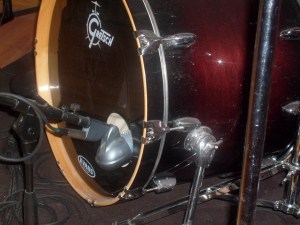
Shure PG52 micophone in a Gretsch bass drum
Even straight into the board that should give you a reasonably good sounding kick drum track. If you want it to be awesome, run it through a preamp/compressor. We use an Avalon VT 737SP set for bass drum.
If you try all this and you aren’t happy I can guarantee you it’s not the Avalon or the Shure PG52 that’s the problem. It resides in your drummer or in the kick drum. Keep experimenting and eventually you’ll make it happen. If you fail or rather, tire of experimenting Nashville Trax does offer drum tracks played by a studio pro session player as well as vocal tracks, piano tracks, bass guitar, you name it you can add to your project. Visit the link and check the menu under the word “MORE” in the upper right corner. b.e. watson
Great Day of Tracks Online Work At Nashville Recording Studios
Posted: February 21, 2014 Filed under: Now Tracking, Studio Services, Tracks Online | Tags: Banjo Tracks Online, Jenee Fleenor, Mike Duchette, Nashville music producer Bill Watson, nashville trax recording studio, piano tracks online, Sir Ronald Fairchild, steel guitar tracks online, The Oak Ridge Boys Leave a comment
Our fiddle player, Jenee Fleenor solos at a Martina McBride concert. Jenee is available through Fiddle Tracks Online to play on your song, just one of the many world class players on our roster!
A great day of work for our new service, Tracks Online, which offers self-producers high quality instrument tracks over the Internet.
First a 10 a.m. at Nashville Trax Recording Studio to record four tracks of Mike Duchette Steel Guitar Tracks Online and two tracks of harmonica.
Then it was off to our Pro Tools HD sister studio in Hendersonville, TN to produce seven tracks of piano and strings played by The Oak Ridge Boys long time band member, Sir Ronald Fairchild, for our Piano Tracks Online service on a project for a client in Quebec, Canada.
Just in time too, Ron had to catch the band bus to the airport at 4 a.m. for a flight to play at an Oaks performance in Puerto Rico. Five star hotels, a one day paid layover to do some sightseeing, catered food, all to do a one hour show…hey it’s a tough life but somebody has to live it!
Finally, caught up!
Until returning to the studio where a Banjo Tracks Online order had just been confirmed via e-mail. The client’s mp3 will arrive in a few hours. Love it!- b.e.
Need an instrument track? Saxophone? Harmonica? Dobro? Mandolin? Nashville music producer Bill Watson will choose the perfect session player to add to your mp3 mix and send it back as a high quality .wav file that will lock up perfectly for your mix and give you exactly what you need to make an impressive, spectacular song demo or master!
Brandon Chase added to Nashville Vocal Tracks Online Service!
Posted: February 18, 2014 Filed under: Studio Services, Tracks Online | Tags: Brandon Chase, country singer Brandon Chase, Nashville Trax Online service Leave a comment
Country Singer, Brandon Chase
You know him from The Voice with Blake Shelton, but for a limited time you can have Brandon Chase sing your demo! This is your chance to catch a rising star!
He’s working on his first album right here in Nashville and is eager to sing on demo projects.
With our over-the-Internet service, Nashville Trax Vocal Tracks Online service, the singer you choose from our roster will sing to the mp3 you send us of your home-produced, or local-studio-produced project!
We return a high quality .wav file in the format that works with your digital audio workstation, it locks right up automatically!
Why not have Brandon sing your tune? More info can be found by clicking on Brandon’s picture above.
Sax Tracks Online! Real, Custom Saxophone Tracks For Your Self Produced Project
Posted: February 9, 2014 Filed under: Studio Services, Tracks Online | Tags: John Heinrich, Nashville, Sax Tracks Online, saxophone, session player Leave a commentHave a Nashville session sax player, the sensational, John Heinrich, ready to add his work to yours! Oh it will sound so good!
Check out:
You don’t have to worry about what microphone to purchase. No worries about acoustics or microphone placement. No fretting over where you can find a great sax player who can actually deliver you a useable track. Just make an mp3 mix, e-mail it, pay via Pay Pal and a pristine sax part played by the amazing John Heinrich comes back at you in no time!

John Heinrich, Sax Tracks Online
Mr. Mike Rocks : Steel Guitar Tracks Over The Internet
Posted: February 6, 2014 Filed under: Studio Services | Tags: Bonnie Raitt, George Jones, mike Douchette, Neil Young, pedal steel solo, Peter Frampton, steel guitar tracks over the Internet, Tammy Wynette, ZZ Top Leave a commentIf your project needs excellent pedal steel guitar, rather than hire a local player consider getting your steel guitar tracks over the Internet.
Why?
Because there are no frets steel can be pitchy. Because steel can be hard to control, it needs to be played evenly and smoothly. Because steel needs to fit into a track like a hand in a glove you need a player with extensive experience at doing just that. And because tone quality is everything.
To get all that you need a Nashville session quality player. Our pedal steel player, Mr. Mike, available through our Nashville Trax Recording Studio service, Steel Guitar Tracks Online, is your guy. He delivers world class tracks on demand. His resume is so extensive it would require pages to list every famous artist he’s worked with but a few of his performance and recording credits include: Bonnie Raitt, George Jones, Tammy Wynette, Peter Frampton, ZZ Top, Conway Twitty, Neil Young…some of the true legends of rock, blues, folk and country.
Here’s Mike just ten days ago getting cued by Billy Gibbons to play a solo in ZZ Top’s “La Grange” with Peter Frampton and Randy Bachman (BTO) staring him down. He nails it, of course. The pedal steel solo begins at 5:18:
Like everyone who is a regular on the roster here, Mike is a Christian and well knows his talent is a God-given gift. If you’re a player wondering how you can have a career like Mike’s don’t emulate his playing, develop your style and emulate his faith in God. It’s He who makes amazing things happen.
Mix Music Online Offers You Professional Mixes of Your Music Tracks Over The Internet!
Posted: January 24, 2014 Filed under: Studio Services, Tracks Online | Tags: bass guitar, Mix Music Online, Professional Mixes of Your Music Tracks Over The Internet, vocals Leave a comment
Your Mix CAN sound Professional!
Can you record good solid music tracks: guitar, drums, bass guitar, vocals, etc. but find you don’t get very good results mixing?
We can make an excellent mix of your song!
For pricing and additional details check out:
How to Earn Income from your Songs on YouTube!
Posted: December 22, 2013 Filed under: Songwriting and Career Promotion, Studio Products, Studio Services | Tags: AllMedia, earn money songs on YouTube, Gary Nowak, Gasoline, MicroSync, Miracle at Work Leave a commentGary Nowak operates a business on YouTube using our productions of his original songs. His latest A Miracle At Work is just getting started.
The first, titled Gasoline featuring actor Christopher Rigali is closing in on a half million views! Chris is an awesome actor and has superb lip syncing skills. It really looks like he sang it!
YouTube compensates songwriters several ways and you don’t have to be on a major label, any independent songwriter can create a song video and post their song on You Tube.
1) Independent songwriters are paid for advertising revenue clicks on their video post.
2) Your music is made available for licensing to professional and consumer content uploaders. You get paid each time your music is played as featured or background music in someone else’s video.
3) You get royalties for original song material video plays.
Besides continually pitching the majority of our catalog (of client song demos and masters) to our major label and top independent label contacts, if you’re not computer savvy, we can create a video of your song for you, then post it on YouTube.
We can also place your songs on Amazon.com through Amazon.com’s Advantage program; on CD Baby and their associated AllMedia and MicroSync programs, on TuneCore etc. to make your music available not only on YouTube, but also through licensing channels for TV, film, video games, and more.
We can place your single demo on Kickstarter and request funding for a master recording or a full blown CD, video and promotion.
Of course there are more traditional ways to profit. Your songs could be picked up by a producer looking for songs for an artist, they could be featured in an indie film or placed on a network TV show.
Like the idea of making a pro version of your tune and posting on You Tube to see if you can pull in some bucks? Want us to produce a song for you? Send your rough MP3 to nashtrax@bellsouth.net and request a quote today!
How Much Does It Cost to Record a Demo?
Posted: December 12, 2013 Filed under: Song Demo Tip, Studio Services | Tags: background vocals cost, How much does a demo studio cost?, pre-producton charting, sell your song, What do session musicians cost per song? Leave a comment
If you’re wondering “How much does it cost to record a demo?” the answer is, it depends on the quality of the two major elements: the recording studio costs and the talent. Like most things, you get what you pay for.
In this article we’ll cover typical studio rates, session musician fees, give a few cautions to prevent you from wasting your hard earned money, then put a mock quote together, typical of a quote we’d give here at Nashville Trax.
You are probably also interested in opportunities to pitch or market your song after your demo is made. Here is a free list of major label and independent label song pitch opportunities.
Why is quality in every aspect of the demo making process your best bet?
A cheap pair of shoes from Dollar Bargain may not be as stylish, may not ne as comfortable or last as long as a pair from a high dollar shoe store, but they’ll basically do their job. Unfortunately, unless your demo is for “family and friends only” a cheap demo almost surely won’t. Your shoes aren’t looking to “take first place” in a lineup of competing shoes. Your shoes aren’t going to be scrutinized by a gauntlet of professionals before you can “win the big prize” (a publishing contract, an artist deal with a record company or a major label recording).
If your goal is simply to have a demo made for your family or friends then B list musicians or a one man band style demo using a drum program instead of a session drummer may be good enough.
Aiming for that big prize? That publishing deal? The major label contract? Wear cheap shoes, spend the extra bucks on your demo, it’s a better investment.
These days most A&R people are straight-from-college, wet-behind-the-ears newbie interns with little experience and little ability to hear a gem in the rough, you must spell it out for them. If it doesn’t sound pretty close to a radio hit and/or doesn’t sound as good as the song from a hit songwriter with an unlimited demo budget they just screened two minutes ago, they will delete your mp3 or toss your demo CD in the trash before it even hits the first chorus.
If you’re in this songwriting business to play games, to toy with it, by all means, do a three or four hundred dollar full band demo and kid yourself you have a shot. If you’re serious about getting your songs cut, do it right: Make the investment needed to be in the game for real, $300 doesn’t even cover the fees a full band of session quality players charge. No matter what the studio claims, you are not getting quality for that price. In the long run it’s not that much extra to get session quality on a demo you’ll be proud to play in any professional-scrutiny-situation the rest of your life.
The costs discussed here reflect what professionals in the music industry who do stellar work charge, not semi-pros or hacks who do “passable work” or “pretty good work”. Pretty good doesn’t win you that one open slot on a recording project. Stellar might.
So let’s crunch numbers: the “talent” portion in the talent/studio equation mentioned above includes the singers, musicians, arranger, engineer and producer. Typically the costs about to be discussed are part of a turnkey package quote as in, “We’ll demo your song for $1.150” or whatever price the demo service arrives at.
Price alone isn’t the only test of a quality service. There is more than one active demo service a.k.a “recording studio” here in Nashville, including one of the biggest on Music Row, that subs out every full band project. They charge between $400 to $1,000, then hand your song off to one of their subcontracted studios for about 50% of what you pay. They pocket the other half for fifteen minutes of simply forwarding your rough materials to a subcontracted studio, getting the completed project back and giving you back the finished mix.
How does a sub do a demo for $250 or $500 when even the full $500 would not be enough to hire pro session players, a pro vocalist and do a quality, multiple hour mix, let alone cover the studio costs, engineering fees, etc.?
They cut every corner possible. They write quickie charts then hire sub-par C list musicians, one or two singers and run 20 songs at a time, assembly line fashion. Instead of spending approx. eight to ten hours on your song, the time required to do quality, each song may receive a grand total of forty=five minutes to two hours of attention, next!
It’s called sharking and that particular Music Row studio’s name on a project is a red flag to industry pros. It’s cheaper yes, but is that really what you want? A ripoff product and the scarlet letter of shame?
So how much does a legit demo studio cost?
First, caution number two, when choosing a studio, get what you need, but not more.
Most good demo studios charge in the $70 to $150 per hour range. Don’t go below $70 per hour on the studio time portion because then you’re scraping bottom barrel so the equipment probably isn’t very modern or very high quality, there will almost surely be issues (dirty pots, noisy analog cords and connections, gear that doesn’t work properly, etc.) and those issues will almost surely show up in the music itself. Above $150 per hour and you’re likely getting into master session audio/video studios that are charging for equipment and recording spaces you probably don’t need to create a good demo.
Musicians and engineers vary in quality too. The timing and chart reading experience required to be a successful session player is far above that needed to play a live gig. The timing part can’t be emphasized enough. Use live players who aren’t seasoned studio vets and the music piece almost surely won’t lock together the way music played by seasoned session quality players does. Impeccable timing is a rare talent that session players seem to be born with.
And some engineers have “great ears” some don’t.
To better understand why it’s important to get “session quality musicians” you should know: the majority of musicians who come to Nashville intending to break into the session scene, the “best of the best” back where they come from, mistakenly think they’ll easily compete with a bunch of “country three-chord-playin’ bumpkins” but have no idea what they’re getting into.
Instead of “easy pickin’s” they typically have their behind handed to them on a platter. The majority fail miserably at session work attempts and end up either focusing strictly on live work which is less demanding musically and less competitive here, or return to where they came from, broke, embarrassed and broken.
You want the players who work sessions daily.
Experienced session quality musicians cost per song
For a demo session, musicians typically charge the studio (with no markup on the studio end) are about $50 to $125 per instrument per song, occasionally higher in certain situations. Guitar, for example, usually requires multiple tracks (lead, rhythm, acoustic, etc.) so guitarists usually make more per song. Ditto keyboards, live strings and a few other instruments.
Rates are generally higher if you are doing only one song. Multiple songs can sometimes knock the per song price down a bit. At our studio, Nashville Trax which is the physical studio we use for our Play It Again Demos service, we usually discount for multiple songs as well as for doubles, passing on player discounts to our customers. For example, both our fiddle players play mandolin at session quality and for a same song second pass on mando they already know the tune so they’ll charge less for that pass.
Singer’s fees are all over the map. Decent singers start around $80 per song for a lead vocal with 1 track of self-harmony. But some charge as high as $250 or even $350 per song, and get it, because they’re that good, that in demand. Typically the singers charging over $175 per song do a lot of major label work. and maybe you do need a vocalist of that caliber. But we can almost always get an excellent singer, perfect for your song, in the $100 to $175 range.
Let’s put together a quote for a basic 4 piece band demo:
A typical 1 song band demo requires about one day or a little more of studio time for the pre-production charting, rhythm tracking, overdubs, vocals and mixing. So at least $560 there. That does usually include the engineer.
It may or may not include the producer’s fee. Here at Play It Again Demos, or Nashville Trax, it does.
2 musicians at $75 each and 2 at $125 = $400
Add the singer we need to put the song across properly, let’s assume a $125 per song rate. Our philosophy: the singer IS the song, pay what you must to get the right one. That isn’t necessarily the most expensive one.
TOTAL: $1,085.
TOTAL with optional mastering for that “radio ready polished” sound: $1,200
TOTAL to add two more instruments and include mastering: $1,400
Note that each song is different. Some are lengthy, some short, some need a more expensive singer to put it across properly, The actual cost is going to vary and could be as low as $795 or so, but those are pretty reasonable ballpark figures.
Typically the majority of the full band demos we produce here, using session quality singers and players, land between about $875 up to $1,200.
Also note that stacked or extensive background vocals, or certain high profile musicians, often cost more. Horn sections cost more. a more elaborate mix. A 6 piece band instead of four…these elements can push a demo up quite a bit. A $1,200 to $1,500 total cost for a one song demo is pretty common for that sort of layered, extensive track work. Adding an extra musician adds their fee, extra record time and extra mix time.
If you think something simpler, such as a piano/vocal demo will get your song across, you can cut back to about 2.5 to 4 hours of pre-production and studio time depending on complexity. A piano/vocal usually lands at about $250 to $350.
So now instead of asking, “How much does it cost to record a demo?” you can figure out what instrumentation is required, do the math and know approximately what a demo should cost.
********************
ADVERTISEMENT:Or hit us up for a quote! E-mail your mp3 rough and a lyric sheet to:
nashtrax@bellsouth.net Att: Bill Watson
* By definition, a demo is intended to demonstrate the song with the intention of playing it for friends. family, industry professionals etc. it’s not usually intended to be sold publicly so the rates charged by services and musicians for demos reflect that. There are also other levels of recordings usually demos that later get the mastering process called “limited release” that give you a license to sell a certain number of CDs or downloads (for example a limited release project permits sales of 10,000 downloads or 2,500 CDs).
**An upgrade of your demo to limited release will add $100 to $200 to the costs detailed above.
 A Songwriting & Recording Blog