Upgrading Pro Tools HD 7, HD 8, HD, 9, 10 or HD 11 : Gear Glut Alert!
Posted: October 19, 2013 Filed under: Music Industry News, Pro Tools Software | Tags: 64 bit AAX, HD 10, HD 11, HD 8, HD 9, Leopard, Lion, Mac OS X, Mountain Lion, Pro Tools HD 7, Snow Leopard, Tiger Leave a comment
Aural Exciter Software for Pro Tools HD running on Snow Leopard
So a rather large monkey wrench has been tossed into the Nashville music machine recording engine! Avid has released Pro Tools HD 11 and it doesn’t play well at all with much of the the gear required to support earlier HD versions. Used Accel PCI and PCIe cards, digital converters and more are being dumped on the market as studio owners realize their gear is dated, and if they intend to move to 11, nearly worthless. Control 24 mixer control surfaces that cost about $8,000 new a couple years ago are not supported in PT 11 and are being offered as low as $2,250 on eBay, with few takers. I suspect it will be tough to get $600 for one in a year or two.
Almost all professional grade studios and most project studios in the Nashville area use Pro Tools HD (Or HD2 or HD3) software. Home studios and others may run Cubase, Logic or regular Pro Tools but Pro Tools HD is king in dedicated pro studios. On my last project I worked in three different studios around the area. Because my home base, Nashville Trax runs Pro Tools HD2 and the others run HD too, it was easy to interface with the other two studios by transporting the music files on portable hard drives. No individual file consolidation necessary, just click on the PT session file icon and the song session opens, ready to go, sweet!
HD is far more expensive than regular PT because it’s more robust and has more features. The initial software cost alone is $6,000 to $11,000 more than the $300 to $600 regular Pro Tools costs. Plus you need expensive hardware too, each piece costing in the multiple thousands. Now most studios that move to 11 will upgrade from an earlier PT HD version so the pain of acquisition will be greatly mitigated, but it still isn’t cheap. For example, going from 7 to 11 is a $2,500 jump.
The big problem, and I heard this from several fellow studio owners, then confirmed it on Avid’s website, is that PT HD 11 supports no plug-ins (for quality reverb, EQ, compression, etc.) from earlier versions. If you’ve invested in $50K of extra plugs and you’re running HD10 you either stay with 10 or try to sell the plugs while you can, usually for pennies on the dollar. But a lot of engineers swear by their favorite plugs and won’t give them up without a fight. Many plugs don’t even have comparable 64 bit AAX versions that will work in 11 yet.
“I can’t afford to move up; I have way too much invested in plug-ins.” one owner confided.
“Avid has ticked off a lot of people in this town with 11 and lost some customers,” said a session musician.
I suspect there will be much kicking, screaming and gnashing of teeth, but most studios will eventually cross the bridge to 11. Nashville is a world class recording environment and PT HD is still the best thing on the planet.
So a lot of studios that ran early PT versions for years are taking advantage of the used gear glut and upgrading to a higher level of HD or moving from PT to PT HD. But that can be a nightmare because the operating system on the studio’s Mac (Pro Tools HD runs better on a Mac so few serious studios use PCs/Windows) must match up with the version you’re upgrading to.
To help fellow up graders out I thought I’d post some useful info:
To upgrade to HD7 you’ll need to run the Mac Tiger operating system 10.4.2 through 10.4.8. The old G5s often had it as well as Mac Pros. Beware of purchasing one of the short-run Intel Mac Pros from around 2006 unless you get the original disc or unless the Tiger version your upgrade requires is already on it. The Tiger OS X disks for the Intel machines were machine-specific. Otherwise, there are lots of retail Tiger versions for Power Macs and G5’s.
There’s little difference between PT HD 8 or HD 9 and 8HD licenses are dirt cheap. But if you can afford to jump to 10, do so, a lot of pro studios will be hanging at 10 for at least another year or two, some for good.
Also, check out the limit your computer will upgrade to! If you’re trying to jump from Tiger 10.4 to Mt. Lion 10.8 it’s not likely to happen.
HD 8 requires Mac OS X Leopard 10.8.0 to 10.5.8
HD 9 is Snow Leopard 10.6.2 to 10.6.8
HD 10 is 10.6.7 Snow Leopard to 10.7.4 Lion
HD 11 requires Mountain Lion.
Be careful, I’m talking about software. If you purchase any of those cats you should NOT hear a GRRRRRRRRRRRRR!!!!!!!!!! If so, forget exchanging it, run for your life : ) b.e. watson
Do you produce music at home or in a commercial studio? Did you realize how inexpensive and EASY it is to get a Nashville session quality player on your projects? Yes, make your project better or even make a profit! Tell your country music clients you have Nashville quality pedal steel guitar and fiddle tracks available and they’ll sell themselves! Add a markup and voila, easy money in your pocket! Or how about saxophone? Harmonica? piano? Bass guitar? Acoustic? Electric? Mandolin? Vocals? You name it, we can probably do it?
Posted: October 17, 2013 Filed under: Music Industry News, Songwriting and Career Promotion | Tags: Nashville songwriting, The Music City Songwriting Competition Leave a comment

The Music City Songwriting Competition is accepting entries in just about any genre or category imaginable. No instrumentals though.
Entry fee is $30. A pro demo isn’t necessary to enter but considering many entrants will be from cogs in the the Nashville songwriting machine who always do great demos; it’s questionable if you’ll win without one, we believe it’s a very good idea.
Click through the link for more information.
Music publishers Looking for Songs for Carly Pearce and Kenny Chesney
Posted: October 3, 2013 Filed under: Song Pitch Opportunity | Tags: Carly Pearce, Kenny Chesney, Music Publishers Looking for Demos, Music publishers Looking for Songs, Paul Worley, Sony Nashville Leave a comment
Sony Music Publishing, Nashville
Speaking of Sony Nashville, word has it that producer Paul Worley is looking for songs for a new artist, Carly Pearce. Meanwhile, also for Sony, producer Buddy Cannon needs tunes for Kenny Chesney by late October.
But do not try to submit directly to the producers or the label, they don’t accept unsolicited materials, won’t accept phone calls from songwriters, etc. The best route onto one of these projects is by getting your song professionally demoed and signed to a song publisher who has a relationship with the label.
So what are you waiting for? Send your rough on an mp3 to nashtrax@bellsouth.net and ask for a quote.
There are also independent music publishers looking for songs that fit these two projects. File this under Music Publishers Looking for Demos.
If you’re sure you already have a demo that absolutely, positively meets industry standards (pro session quality musicians, pro singer, professionally mixed, nothing semi-pro or home quality about it) you can submit .wav files via Hightail.com or e-mail MP3, MP4, AAC, or AIFF files (1 type of file per song! 2 song max) to music publisher Michael Bright of Bright Songs Publishing at brightmusic3501@gmail.com.
Sony Music Hires New A & R Director
Posted: October 2, 2013 Filed under: Music Industry News | Tags: Arista, Columbia, RCA, sony, Sony Music Nashville, Taylor Lindsey Leave a commentSony Music Publishing, Nashville
A new A&R Director has been hired for Sony Music Nashville. Taylor Lindsey. Her duties will also include A&R for the Nashville branches of Columbia, Arista and RCA.
Basket Case: A Nashville Session Player Band
Posted: October 2, 2013 Filed under: Nashville Session Musicians, Samples of Our Work, Session Player Stories | Tags: Basket Case, Bill Watson, David Northrup, Jon Smith, Kristen McNamara, Rodney Ingle, Steve King, The White Coat Band, Tigar Bell, tom wild Leave a comment
Basket Case
Basket Case at 3rd & Lindsley, Left to Rt: Steve King (keyboard); Holly Steele (background vocals); Rodney Ingle (background vocals); Tom Wild (guitar); Kristen McNamara (lead vocals); Bill Watson (bass guitar/bandleader); Tigar Bell (fiddle) ; John Heinrick, (sax). Background: David Northrup, (drums).
I received the first e-mail from songwriter Jon Smith back in my short hair days, 2005 I believe, saying he was disappointed with the work he’d received on his songs at several other Nashville studios and asking that 5 songs be produced for him at a budget far higher than any I’d experienced up to that point. The previous attempts to record his songs were interesting and the musicians competent, Jon said, but the music was flat, bland. There was no magic that he was sure was there.
We found it.
That initial e-mail led to multiple sessions totaling over 80 songs, a friendship, lots of rehearsals at S.I.R, and Soundcheck Nashville, a CD release, two videos and this live band that played Jon Smith tunes at venues in the greater Nashville area. What great fun it was!
Over the years of producing those sessions I used a lot of different top Nashville session players, excellent musicians all, but when Jon asked that a band be assembled so he could hear his songs performed live, I chose the ones I considered not just great musicians and singers, but also friends.
And my friends came through big time, the band sounded fantastic!
We initially resisted Jon’s suggestion that the male members wear white coats, but it turned out to be simply one more stroke of Jon genius. We only did a few gigs but quickly became known as “the white coat band” and it was memorable enough people still mention it occasionally, always referencing the white coats.
Here’s a swingin’ little tune that always made the setlist:
My Tears Are Puttin’ Out Your Fire is © 2007 Jon Smith. Co-writers: Jon Smith/Bill Watson, produced by Bill Watson. Used by permission.
That’s the studio version of MTAPOYF I produced in ’07 using mostly the same band pictured above.
Jon’s work was where I learned how to use horns effectively as opposed to creating a train wreck. Arranging, doubling, combining different horns together, stabs, swells, stacked horn tracks… if you have a tune you need sax, trumpet, clarinet or trombone on, or any combination of them, you’re at the right place! Send out an e-mail to nashtrax@bellsouth.net and ask for a quote!
I have the vids around of the band yet too and when I get around to it, will post some footage- b.e.

Left: David Northrup drums, Bill Watson Bass Guitar. No wonder the band was called Basket Case. Two prime examples for sure!
BMG Chrysalis signs Wynn Varble
Posted: October 1, 2013 Filed under: Client News, Music Industry News | Tags: BMG Chrysalis, Wynn Varble Leave a comment On September 26th, 2013, Wynn Varble signed with BMG Chrysalis Nashville as an addition to their songwriter roster.
Meet The Producer : Nashville Trax and Play It Again Demos
Posted: September 28, 2013 Filed under: Nashville Session Musicians, Studio News, Studio Products | Tags: Bill Watson music producer, nashville trax, play it again demos Leave a commentThe music producer, and sometimes engineer at the Nashville recording studio Nashville Trax and the over-the-Internet song demo service Play It Again Demos is Bill Watson. Mr. Watson brings years of experience with song structure, lyrics, arrangement, recording and production to your project. He will choose the perfect session quality Nashville musicians and pro session singers for your song.
He’s known for taking a songwriter’s rough work, no matter how sketchy it is, and transforming it into something amazing. Check out our samples, hopefully you’ll agree.
“I certainly hope you choose our services because I know we can do far more with less for you than any other service out there, but even if you don’t I wish you much luck in your musical endeavors. And far more important, may you find peace and happiness in this life and beyond.”-Bill Watson

Bill Watson, music producer @ Nashville Trax Recording Studio, and Play It Again Demos
How To Write A Lyric If You Don’t Know Music
Posted: September 24, 2013 Filed under: Songwriting, Songwriting Tips | Tags: How To Write A Lyric If You Don't Know Music, Lyrics aren't poems, Metronome Online Leave a comment
To write a lyric successfully, the music framework it will sit on must be accounted for. Lyrics aren’t poems. Lyrics are restricted by elements poems aren’t, elements that are part of music. This post is intended to get you thinking properly and give a concrete tip or two you can use, by no means can we completely explore this topic here.
The biggest restriction on a lyric will be the measures (a.k.a. bars) each line has to exist in.
In 4/4 time there are 4 beats to a measure. The typical 4/4 song has 4 bars to a phrase, so 16 beats, and the beats are evenly measured. Let’s pull up:
Click at the top of the circle to fill the dot above “92” and it will begin to click at 92 beats per minute. That’s a medium tempo, not real fast, not real slow.
Count along each time it clicks. 1-2-3-4, 1-2-3-4, 1-2-3-4, 1-2-3-4.
Every 4 beats a new measure begins. In four bars of music those 16 beats are exactly how long your initial phrase should be. If each word gets 4 beats you could write four words total each receiving 4 beats: How about “I don’t know you.”
I don’t know you
1- 2- 3- 4, 1- 2- 3- 4, 1- 2- 3- 4, 1- 2- 3- 4
You are writing whole notes. Whole notes get 4 beats.
For the next phrase let’s use half notes, each word receiving only 2 beats except on the word “very” where we’ll give each syllable only 1 beat, so they are quarter notes:
and I do not like you very much
1 – 2 – 3 – 4, 1- 2- 3- 4, 1- 2- 3- 4, 1- 2- 3- 4
As you can see, unlike poetry where lines can be free form, music tends to impose restrictions that are mathematical in nature. Using an x to represent a measure, typically music in 4/4 looks something like this:
Introduction: x x x x
Verse 1: x x x x / x x x x
x x x x / x x x x
Chorus 1: X X X X / X X X X
Vere 2: x x x x / x x x x
x x x x / x x x x
Chorus 2: X X X X / X X X X
Bridge: x x x x / x x x x
Chorus 3: X X X X / X X X X
Chorus 4: X X X X / X X X X
If you chart out a basic diagram of the song format then start the click at the appropriate tempo you can write to it, ensuring the lyric will sit nicely in the music once it’s written- b.e. watson
Now Tracking : The Darker Side Of Love
Posted: September 23, 2013 Filed under: Client News, Now Tracking | Tags: play it again demos, pre-production, rockin country, Steve Zodiak, Tom Hogan Leave a comment
We’re finally getting around to the tracking of Tom Hogan’s (a.k.a. Steve Zodiak, his fictitious online name) “The Darker Side of Love” which was the subject of a previous post. It took a while to make some pre-production decisions and get the financials in order.
Love the tune! Uptempo contemporary country with a female vocal and lots of bgv’s. It’s “The Works” level demo ($1,200) so it’s also getting drums, bass guitar, two guitar tracks, fiddle, mandolin and harmonica with the harmonica and fiddle trading licks on the solo section. Steve said, “Make it Rockin’ Country!”
No one has to ask me that twice, LOL. Charts are complete and we’re ready to cut rhythm tracks on this bad boy.- b.e.
10-12-13 Update: Here’s the finished mix.
1 lead vocal track
2 harmony vocal tracks
10 Drum kit tracks (10 separate tracks with each drum microphone getting a separate track, kick, snare, top head, snare bottom head, etc.)
1 bass guitar track
2 split acoustic guitar tracks, panned wide
2 chorused clean electric guitar tracks panned wide
1 distorted rhythm electric guitar track
1 harmonica track
1 fiddle track
1 steel guitar track
1 mandolin track
The Darker Side of Love is © 2013, Tom Hogan, used by permission of the songwriter. If you’re interested in recording this song please let us know and we’ll forward your request to the songwriter and music publisher.
Tom’s comment on 11-17-13: “Thanks for all you’ve done. I’ve nothing to say but good things about the “Darker Side of Love” project.”
How do you like that harmonica work? It adds a lot, eh? And that awesome fiddle trading licks with the harmonica on the solo?
How would you like to be pitching work of this quality?
I can happen! Send us a copy of your working rough mp3 at nashtrax@bellsouth.net and request a quote today!
Pre-Production : What Is It?
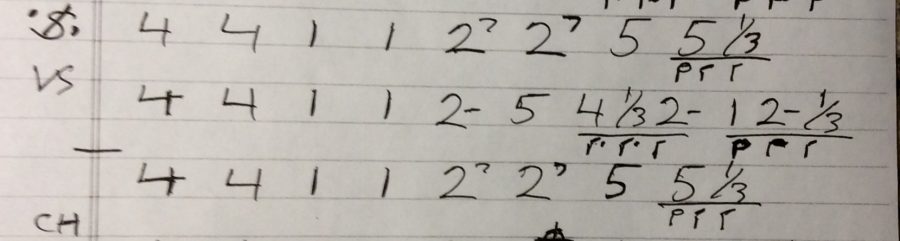
Posted: September 13, 2013 Filed under: Client News, Songwriting Tips | Tags: full band demo, limited release, nashville numbers Leave a comment I’ve set aside 1.5 hours this morning for pre-production on an original song titled “Into The Light” by songwriter Timothy Demming.
Tim ordered “The Works” level demo ($1,250.00) which is a full band demo including lead, harmony and background vocals, a 6 piece band including doubling of tracks where warranted, mastering, and radio ready mix. It comes with a limited release license for up to 10,000 copies to be sold, either via download, CD or other means.
I loved Timothy’s rough and I’m excited to get started!
What happens in pre-production? This is the time production notes are made, the songwriter’s notes are reviewed, the arrangement is created and Nashville Number Charts are written. It’s also when the singer and musicians who will be on the session are chosen.
If I hear flaws in the song’s construction, be it in the lyric or in the music, I’ll shoot out e-mail(s) to the client noting the perceived problems and possible fixes. I realize that what I see as a problem may be something the writer did intentionally and wants to keep, which is perfectly okay.
Common problems resolved at this stage are:
- Extra bars that aren’t needed
- An odd number of bars that need to be evened out so that portion of the song doesn’t feel “left footed.”
- A line that is so wordy the singer won’t be able to squeeze it all in without sounding unnatural.
- A chord choice that doesn’t fit the progression or the melody.
- A melody that isn’t supported by the chords.
- Tempo slightly faster or slower than ideal.
- Weirdness. I can’t explain this exactly other than to say songwriters, left to their own devices without input or guidance, often do strange things, especially in the lyric. For example, they may write a complete song built on a concept that, unbeknownst to them, could also be taken another way they never thought of. Can you spell “sexual innuendo” and place it in parallel to a normal lyric in a sweet old ladies’ gospel song? Not the best idea to let that out in public, she needs some gentle guidance.
Or sometimes a song is just plain weird beginning to end: “What Does Santa Give Huskies for Christmas?” comes to mind. Perhaps there are some questions we just don’t need an answer to. Gentle. Guidance.
I don’t address things like pitch issues, tone or musical ability of the singer and players on the rough. If the songwriter making the rough version had perfect pitch, great tone, could play at session quality and do great arrangements what would they need us for? I expect those elements to be pretty raw, just send in the best rough you can muster. I’ll review your song, not how well you perform it.
Jesus will judge you someday, it’s not my gig : )- b.e.
Songwriter’s Market 2014
Posted: September 12, 2013 Filed under: Songwriting | Tags: Songwriter's Market, Songwriter's Market 2012, Songwriter's Market 2013, Songwriter's Market 2014, songwriting Leave a comment
Is Songwriter’s Market 2014 still serving the songwriting community?
Is Songwriter’s Market 2014 showing the long tooth?
At one time Songwriter’s Market was a useful tool for pitching songs to publishers and record companies. But things have changed in the songwriting world. Times have changed.
Many songwriters complained about Songwriter’s Market 2012. According to most, it was badly in need of updating. One buyer revealed that most of her 2012 submissions came back unopened and undeliverable. Most comments on various retail sites are negative.
Songwriter’s Market 2013 had little updating from 2012 so if anything, it was even less useful.
What has changed since the early days of publication?
Songs are more in demand, not less. At one time there were three major TV networks, major motion pictures, PBS and radio. If your songs weren’t played in those places you weren’t making much money. Now there are far more outlets. Look at television alone: Hundreds of channels, most of which use music.
Internet websites, radio and Internet advertising use vast amounts of music already and use is increasing as the Internet changes from older users with large desktop systems who prefer reading words, to a younger demographic using smaller devices that prefers music and pictures. Music helps sell.
There are newer, universally accessible and arguably better ways to get exposure for an act than there were when Songwriter’s Market began publishing. YouTube, Facebook, etc. weren’t available fifteen years ago.
It’s possible the editors have become lazy in updating Songwriter’s Market listings. But regardless of the reason for the decline, it’s still a very useful book for researching music publishers and other music related companies. You can get names, e-mail addresses and more to help you start establishing contact.
But purely as a mechanism for marketing songs it has been coming up short for years now.
Does anyone care to comment on the usefulness of Songwriter’s Market 2014? -b.e.
Play It Again Demos Receives 2013 Nashville Award
Posted: September 6, 2013 Filed under: Music Industry News, Studio News | Tags: 2013, Nashville Award, play it again demos, Receives Leave a comment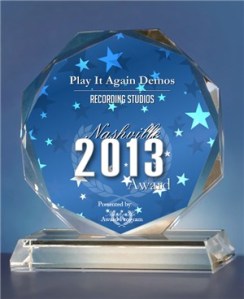
Play It Again Demos Nashville Recording Studio Business Award
FOR IMMEDIATE RELEASE
NASHVILLE September 6th, 2013 — Play It Again Demos has been selected for the 2013 Nashville Award in the Recording Studios category by the Nashville Award Program.
Each year, the Nashville Award Program identifies companies that enhance the positive image of small business through exceptional service to their customers and our community. These companies help make the Nashville area a great place to live, work and play.
The Nashville Award Program is an annual awards program honoring the achievements and accomplishments of local businesses throughout the Nashville area. Recognition is given to those companies that have shown the ability to use their best practices and implemented programs to outperform their competitors and provide long-term value for their customers.
CONTACT:
Jason Taylor
888-731-3985
Email: PublicRelations@awardprogram.org
 A Songwriting & Recording Blog