Songwriting Tip : The Song Concept Is King
Posted: March 8, 2013 Filed under: Songwriting Tips | Tags: concept of song, inside song, michael o' conner, outside song, songwriting tip, unique song concept, unique song title Leave a comment My songwriting mentor, Michael O’Connor of Michael O’Conner Music, based in Studio City, CA constantly stressed the importance of a unique song concept. His company hits were mostly middle of the road and pop songs. (Note that there’s a Michael O’Conner based in Texas who publishes his own songs: not the same guy.) When I got into country music and moved to Nashville I quickly realized that what Michael applied to pop songwriting was even more true when writing country where the chord progressions are often simple and in many cases very little except the lyric separates one song from another. There are many techniques country songwriters employ but I think it’s safe to say, in country, developing a unique song concept is king of the hill.
A unique concept can be defined simply as the “idea of the song” or “what the song is about.” But the concept can also encompass the title. In fact, coming up with a great, unique title is the starting point for many hits.
When you want to write about a particular subject your first thought will likely be a cliché. Write down the cliché then try to outdo it with something that says that same thing in a way no one ever has before. Locked Out Of Heaven by Bruno Mars is a great example of a concept title that’s unique. A good country example is the Jamey Johnson penned In Color. The singer is looking through his Grandfather’s old black & white photos taken at highly emotional moments in his Grandfather’s life as his Grandfather discusses them. Grandad ends each chorus with, “You should have seen it in color.” Powerful. It’s the kind of hook line that resonates so deeply the first time you hear it, it takes your breath away.
Why do you want to mess with this title creating and lyric crafting stuff, why not just let the words pour out and let the chips fall where they may? Because publishers are your best pathway to getting a song cut and publishers know they have a much better chance of making that happen if a song has a unique concept/title than something bland and unimaginative. So their antennas are up for great titles. Impress them with a great one that’s developed into a complete, equally well developed lyric and a phone call to contract your song probably isn’t more than five minutes away. Anyone can write “My Grandad showed me some old pictures and wished I had been there to see it for myself.” Not everyone can boil it down to, “You should have seen it in color.”
The paradox for most songwriters is when they look at the pop or country charts and see clichés or common phrases used as titles and think,”That dude at Play It Again Demos telling me about the importance of great titles and concepts doesn’t know what he’s talking about.” Or they listen to the radio and think, “Hey my song is better, therefore it should be a hit.” If the unpublished songwriter’s song really is better it’s usually because the artist songs were written by the artist or someone with an inside track to them. It’s the artist’s fan base and clout that get the song on the charts and garner sales.
Yes, Hank Williams, Sr. wrote “I’m So Lonesome I Could Cry” and Dolly Parton wrote “I Will Always Love You” two songs that almost surely were outpourings of emotion that came out ready to cut as-is, no tweaking necessary. And both writers had enough experience to know that injecting craft and cleverness was the wrong way to go for those particular songs. But both had their share of songs that obviously were crafted to the max. And most songs by less experienced songwriters fall far short of that out-of-the-gate perfection.
Only compare your work to “outside” songs on the charts that were written by writers who have to run the same gamut of gatekeepers song publishers, producers, etc. you do. In most of those cases you’ll find a unique concept is the catalyst that propelled the outside song all the way to its current position on the charts- Bill Watson
Fiddle & Steel Country Music Demo Sample
Posted: March 7, 2013 Filed under: Uncategorized Leave a commentThe above track is a sample of the skilled Nashville session musicians we use on demos. Steel and fiddle often are used in the same song as they are here.
Interested in having either steel, fiddle or both added to a recording you are working on in your home or studio?
e-mail us at nashtrax@bellsoyth.net or text 615-319-8616
Song Publisher Gabi Kochlani Building Catalog
Posted: March 7, 2013 Filed under: Song Pitch Opportunity | Tags: emi music publishing, gabi kochlani, guns & roses, song publisher seeking songs, song publishng company, third blind eye Leave a comment
Gabi Kochlani, formerly in management for Guns & Roses; A&R for Third Blind Eye; and songwriter management for EMI Music Publishing has formed her own publishing company and is seeking to build a catalog of Top 40 pop/rock, pop/dance songs.
Click Here For More Song Pitching Opportunities
If you need a song demo produced for the Gabi Kochlani pitch, please have your rough in to Play It Again Demos by May 15th, 2013 which will allow us enough time to record it for you before this opportunity closes.
Did You Know? The Revenue Stream From Songwriting
Posted: March 3, 2013 Filed under: Songwriting and Career Promotion | Tags: download income, limited release license, mechanical license, song revenue, synch licenses, ways to make money from songs Leave a comment Are you aware there are numerous ways a song can can produce income? It’s true. There are mechanical royalties; airplay royalties; foreign publishing; synch licenses; sheet music income; download income; ringtone revenue; YouTube views; jukebox and bar band cover tune revenue from licensing fees collected by ASCAP and BMI … it’s a long list and I have to question the wisdom of the songwriters who decide to self-publish. For a few it makes sense, For most it’s, “What are they thinking?”
It’s highly unlikely that most songwriters with no publishing experience have the contacts or experience to fully promote their work. In many cases the money generated by a major label release is the tip of the iceburg with the bigger money being made on covers of the tune by other major label artists; “Greatest Hits of the Decade” type packages; foreign language releases by top artists in other countries and other avenues.
Some songs make substantial money from repetetive upfront licensing fees paid by aspiring artists. When I produce a singer who doesn’t write on a Nashville Trax project I search for suitable songs from our own Play It Again Demos catalog as well as the catalogs of song publishers and begin running them by the artist. In order to be legal to sell downloads or press CDs the artist or their backer has to pay the songwriter(s) upfront according to the type of project. The minimum is a limited release license payment for 10,000 CDs or downloads.
One reason to consider pursuing publishing deals for your songs is it frees you from copyright administration and promotion. You’re most likely a creative type and not particularly good at exploiting a song copyright so why not hand the reins over to a pro while you focus on increasing the herd?- B.E. Watson
Song Pitch Opportunity
Posted: March 2, 2013 Filed under: Song Pitch Opportunity | Tags: bluegrass song pitch, pitch song to grascals, the grascals, the grascals recording Leave a comment The highly acclaimed Bluegrass band The Grascals, based in nearby Hendersonville Tennessee, are looking for bluegrass/gospel songs. Jamie Johnson who has experienced considerable success in his solo career is a member. Recording begins this month so it’s a rush. If you don’t know much about the group please do your homework by checking out their Wiki page, their website http://www.grascals.com etc.
If you have a song you think might work for them and need a demo produced, get the rough on in to Play It Again Demos without delay.
Country Breakout Awards
Posted: March 1, 2013 Filed under: Music Industry News | Tags: blake sheltom, broadway nashville, dierks bentley, florida georgia line get your shine on, kacey musgraves merry go round, margaritaville, miranda lambert, music row, taylor swift begin gain Leave a comment The Country Breakout Awards were held at Margaritaville on Broadway, Nashville 2-26-13 with Dierks Bentley winning male vocalist of the year and Miranda Lambert taking female vocalist if the year honors.
Dierks accepted in person and gave a shout out to his fan club sitting in the front row.
Also, Taylor Made received Independent Artist of the Year while Capitol Nashville won label of the year. The company had over 1/3rd of the 32 No. 1 songs in 2012.
This week’s breakout chart reveals Kacey Musgraves Merry Go Round at #1, replacing last week’s #1, Taylor Swift’s Begin Again, which dropped to #4. Blake Shelton’s Sure Be Cool is at #2 and the above mentioned Florida Georgia Line’s “Get Your Shine On” climbed one position to #11.
Why Are Songwriter Demos So Expensive?
Posted: February 27, 2013 Filed under: Songwriting and Career Promotion, Studio News, Studio Services | Tags: cost of song demo, price of studio session singer, session musician cost, songwriting, why song demos so expensive Leave a comment
This question was asked on a songwriting forum recently and I decided to answer it here. Many demo services and recording studios base prices on what other services charge and try to either beat the other guy’s price a little or up the other guy’s price. That approach reveals convoluted logic, bad business practice and is terrible for clients.
Pricing downward based on competitor’s prices forces a downward spiral in the race to be the “chief bottom feeder.” How can a studio owner be sure the prices they’re using as a guide haven’t already been through the same process?
A good businessman determines prices based on his own costs and need for profit, period. To do otherwise invariably leads to overcharging or not quite charging enough which means cutting corners to ensure a profit is made and it’s the client who always comes out on the short end of that stick.
Equipment necessary to make professional sounding music is not cheap. In the pic above taken at Play It Again Demo’s studio the two digital converters cost over $2,000 each and the high power computer, large enough to run commercial recording software, costs about $5,000. The software it runs (in our studio and most studios in Nashville area, that’s the commercial version of Pro Tools, PT HD ) is about $8,000. The software that runs in it (the plug ins such as reverb, delay, mastering tools, pitch correction, etc.) cost about $100,000. There’s also an expensive control room speaker monitor system as well as computer visual monitors, an earphone monitor system to each tracking musician station, so you’re looking at over $120,000 and that’s just for starters on the computer recording system alone. But oh it does sound good!
The building and utilities also must be paid for. Heating or cooling a building for a day isn’t cheap and electric to run all that gear isn’t free.
So studio rates are typically $50 to $150 per hour, depending on the studio, which may or may not include the engineer/producer. A professional session singer hired for a demo generally costs $80 to $175 per song but some are even higher. And musicians capable of playing at session quality, a rare commodity, are about $50 to $75 per song. The time required to take one average three minute song from rough through pre-production (writing charts), recording rhythm tracks, doing overdubs, adding vocals and doing a demo quality mix is about a one full day per song. The producer and engineer will be present throughout with each musician and singer contributing about an hour to an hour and a half.
Add it up and you can get to a relatively large number fast. That’s just reality.
But reality is also that doing a pro demo is simply the bargaining chip that gets you taken seriously. That’s because you’re not competing with Joe Smith’s home recorded demo made in Iowa, you’re playing poker with pro songwriters with previous hits who can afford to set the demo quality bar extremely high. It’s not that a demo made on a Fostex home quality 4 track recorder can’t get signed, it’s that very few amateur songwriters know how to make that Fostex generate a pro sounding recording. And perhaps not in all, but in most cases, a poor sounding recording equals “amateur” in a publisher’s mind so they can’t drop that demo in the nearest waste can fast enough.
“Expensive” is relative. Is it better to scrimp and save a few hundred dollars on a song demo only to and have a song publisher use it to play trash can Frisbee or is it more intelligent to spend what’s necessary to really get in the game, bowl the publisher over with a compelling piece of music, get signed and possibly get a hit that will return hundreds, maybe thousands of times what you spent?
Which is the better investment? Do you believe in your song or not? If you don’t, who will?
Demo Pitch Opp: Josh Thompson
Posted: February 26, 2013 Filed under: Song Pitch Opportunity, Songwriting and Career Promotion | Tags: josh thompson, song pitch opportunity Leave a commentCountry, male vocal, Josh Thompson.
He’s on Nashville label Show Dog Universal. Show Dog is the company Toby Keith started some years ago.
The pitch deadline is March 7th, 2013 so if you have a song we’ve cut the demo on in the past you think would work for J.T. and believe we should take a look at or have a new song you’d like to have demoed for this (we’ll put a rush on it), get it on in.
Songwriting Tip: Separate That Chorus!
Posted: February 25, 2013 Filed under: Songwriting Tips | Tags: Music, separate the chorus, songwriting, songwriting tip, songwriting tips Leave a comment
One mistake some songwriters consistently make is failure to create a chorus section that’s distinctly different from the verse. You want that chorus to just about shout to the listener: “Okay now: here’s where I’m summing up what this song is about!”
How? A few good techniques to achieve separation are:
- Alter the line length
- Change the rhythm
- Alter the note length
You can use any one of those or combine as necessary. A lyric that has relatively lengthy verse lines but the chorus lines are short and powerful may provide sufficient contrast. A subtle change of rhythm can work and some recent hits take that to extreme such as Jason Aldean’s “Dirt Road.”
We need look no further than the Florida Georgia Line hit, Cruise, for a good example of altering note length. If you sing it and tap your fingers with each syllable you’ll notice the tapping is a lot faster when you reach the chorus “Baby you a song, you make me wanna roll my windows down and Cruise …” part.
A producer has a good number of tools available to create chorus separation via the arrangement but if you can provide it in the structure of the song itself, it makes the song that much stronger and the final product that much more likely to be signed. More songwriting tips are available at the link in the menu to the right- Bill Watson
Artist’s Looking For Songs : Songwriter Tipsheets and Song Promotion
Posted: February 24, 2013 Filed under: Songwriter Tipsheets, Songwriting and Career Promotion | Tags: Blake Shelton, song pluggers, Song Promotion, songwriter tipsheets Leave a comment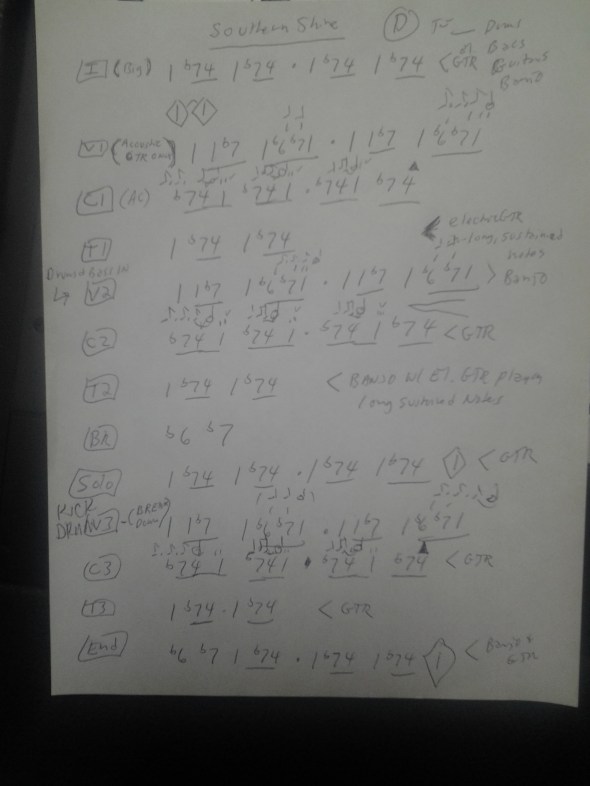
The “Nashville numbers chart” for “Southern Shine” by Dan Thompson. The first indie single we produced for him blew up big time on radio in Europe and Australia. Initially played on the BBC radio network, as I write this it’s currently getting about 2.000 spins a week.
Here’s my opinion on songwriter tipsheets, song pluggers and song promotion– Music Producer, Bill Watson
Before we dive into song promotion via tip sheets and pluggers, let’s look at what you’re promoting
Almost-radio-ready is no longer a luxury, it’s the bargaining chip that gets you into the game at all. If the song demo you intend to pitch doesn’t sound like this you’re probably wasting your time.
These days many A & R people want demos they can hit the ground running with, not re-cut. Anything less gets dismissed as amateur or unusable and gets tossed in the trash can.
The musicianship should be superb, the mix professional. Near record quality. That’s not to say you must always have super elaborate demos produced. Many songs do not need a lot of background vocal tracks, three layers of keyboard tracks or whatever to get the song across. Some tunes need as little as a good solid guitar track and a quality lead vocal to achieve that goal.
* * * * * * * * * * * * * * * * * * * * * * * * * * * * * * * * * * * * * * * * * * * * *
Frustrated with the song marketing process? Have you looked at Song Rocket?
* * * * * * * * * * * * * * * * * * * * * * * * * * * * * * * * * * * * * * * * * * * * *
But regardless of whether a sparse, or a more elaborate demo path is chosen, all elements must sound professional. That means similar to what you’d hear on the radio.
If you live outside Nashville it’s doubly important that you have a superior quality demo to establish your credibility. Right or wrong, most music industry professionals are more skeptical of anything not created here.
Click Here For FREE Listings of Major Label Song Pitch Opportunities
Should you do a full band demo? An all out, spare-no-expense demo? A master? Guitar/vocal? Obviously I make my living producing music so it’s easily argued, possibly with some merit, that I have an inherent conflict of interest. Kicking this question around with songwriter Denise Baldwin, who has no dog in this hunt and is experienced at the Nashville critique/workshops/pitching routine, we arrived at this:
- Most record company A & R don’t have the experience or song sense the old “Tin Pan Alley” music publishers of the 1940’s and 50’s had. Unless you spell out every word, today’s fresh-out-of-college interns assigned to song screening can barely read the book let alone envision it fully illustrated. If they are part of your pitch plan, I recommend at least a basic four piece demo if not a full blown deluxe. Neither option costs that much more than a high quality guitar/vocal. Ditto if you’re pitching directly to an artist.
- A guitar/vocal or piano/vocal may be fine for some music publishers. If so they’ll generally let you know they can “hear it” by requesting a simple guitar/vocal or piano/vocal demo. They have the experience to catch the vision and mentally extrapolate your simple demo into a full blown recording.
- Independent releases don’t run the A&R gauntlet; it’s pure art, no gatekeepers, no rules. Simply be sure your song says and does what you want it to, then it’s fine to go straight to a limited release master or full blown master. As I write this, in fact, everything I’m currently working on is limited release or master level. With so many opportunities available for songwriters that didn’t exist prior to the Internet- radio airplay, download sales sites, You Tube revenue, etc.- songwriters are definitely turning more entrepreneurial.
Previous clients of Nashville Trax who later informed us that their song we produced was contracted by a music publisher, was forwarded to a publisher by BMI.. or got a cut, a hold, got a deal, got radio airplay etc., have never had it happen (that we’re aware of) due to simple one instrument demos.
That fact alone doesn’t mean you should go more elaborate, many Billboard hits started as simple one instrument demos. And not all clients feel the need to contact us after the fact so this point is likely based on limited data, and certainly the evidence provided here is somewhat anecdotal, not empirical, take it with a grain of salt.
Regardless of your intent, do rewrite until your song is the best it can be. Then if you intend to pitch the song to Music Row A&R, consider paying for a critique before investing in a demo. You don’t want to pay hundreds of dollars only to later hear your song lyric is flawed.
Professional critiques are only as good as the song sense, comprehension of song crafting and knowledge of what’s currently getting outside cuts, of the person doing the critique. Get two “pro critiques” and you may well get two very different perspectives that may even contradict each other on some key points; all critiques are colored by opinion. Get one, but once again, the grain of salt thing applies.
Tipsheets: There are some very good ones but those tend to be extremely expensive $175 to $1,500 per year and the best listings usually restrict submissions to professional song publishers with a track record of hits. Contact info in most is not even listed for the big name pitches, you’re expected to have a relationship, otherwise your songs aren’t welcome. The obvious tactic is to get signed with a music publisher who subscribes to the tips sheets so you don’t need to. Your time is better spent writing songs, not promoting them.
The Song Plugger: Some people around town plug songs they believe in for free hoping to get a cut and a percentage if it’s successful. One of my friends does that and she has had a hand in two Billboard #1 hits, one of which she was totally responsible for taking the song demo from the songwriter (Rodney Crowell) and pitching it to the artist who cut it (Keith Urban). In the other instance she was part of the loop responsible for the biggest hit on the country charts in over 40 years (Cruise by Florida-Georgia line). That’s clearly legit plugging.
Not so clearly ethical is the growing trend of the paid song plugger who, for a large fee, I’ve heard of songwriters paying $250 to $2,000 or more per song pitch, will take your song or “the best of your songs” and claim they’ll be listened to “by the right people.” And perhaps some do as they say. But I suspect that in many. if not most cases, it’s a bit of a scam. If you have money they’ll take your song.
But do they really pitch it? Hmmmmm.
We do pitch songs we believe in. The song has to be great, the hook superb. the lyric as good as it can possibly get. And we don’t charge big money to pitch a song, we do it because we believe in it and because successful songs help our business thrive.
As far as a directly pitching to an artist, every recording artist would love to have a hit song handed to them but not every artist or even every song publisher is eager to hear songs straight from unknown songwriters. Why?
Two basic reasons: Time and fear of lawsuits. The majority of song publishing companies and independent publishers here in Nashville are very small operations, 5 to 10 people total. They have staff writers who are paid to write and crank out a lot of songs. Between managing those writers, managing their song output, performing administrative tasks on previous hit songs and such there’s not much time to wade through 2,000 diamonds in the rough to find that one polished gem.
I read once that Conway Twitty attributed his string of #1 hits to personally screening one thousand or more songs for each record, but today recording artists rightly prefer to focus their time on other things. When they need outside tunes they’d rather check out pre-screened songs from publishers they trust to weed out the unsuitable. It’s far more efficient.
And what happens when a song an artist or publisher who is passed on, coincidentally sounds a lot like a song a staff writer wrote and gets a Billboard hit with? A lawsuit, and it can happen so easily. How many songs were written about 9/11? There are bound to be similarities, maybe even matching lyric lines. But of course an amateur songwriter is going immediately to “they stole my song.”
So, what does a songwriter trying to get heard, caught in the catch 22 of needing a hit to be taken seriously but unable to get one because no one will listen, do? The best song promotion is to move to a city like L.A., New York or Nashville and start networking. Get to know songwriters, music publishers and others. Co-write. Attend writer’s nights, etc. If you have talent, the cream always rises. Always.
If moving is impossible then you need someone on the inside to market your songs for you who believes in them.
Some song publishers and producers do listen. Find them and give them something exceptional to listen to. A pro demo may or may not get you a contract but it will keep the door open for future listens, keep you off the “direct to trash can” list and will start building your reputation. Many of our clients have had great success with getting song publishers to sign demos we’ve produced for them.
Attend concerts where you live and get your songs in the hands of band members. If you have us produce your demo, request that we give a copy to the musicians who worked on your song; most play for major recording artists. If your song is aimed at Blake Shelton wouldn’t it be great to have a copy in his fiddle player’s hands? Come in and record and you can hand her your song. Our musicians play for many different artists and we will be glad to hand finished mixes they played on to them. We have had players pitch songs to the artists they work for, but they only do so if they believe in the song.
Or simply have us cut your pro-level demo. While here at Play It Again Demos we don’t promote “just any song from anyone with money to pay” and we do not operate a song plugging service, we do promote a small portion of the songs we demo to song publishers and recording artists using several proven methods. Why? With few exceptions, by the time we take a song from the rough stage to the polished demo stage we believe in it as much as the songwriter– Bill Watson
Avalon VT 737SP Review
Posted: February 23, 2013 Filed under: Studio Equipment | Tags: avalon vt 737 review, doing your session naked, mic pre, pro studio compressor Leave a comment

The Avalon VT 737SP is one of those expensive toys you benefit from when you hire either Play It Again for your songwriter demos or Nashville Trax to produce your project. All vocals we track go through it.
We’ve had an Avalon for years now and it’s a great microphone preamp/compressor/equalizer. At $2,400 list it’s beyond the budget of most home recording enthusiasts, and even some smaller studios, because it alone simply won’t make that big a difference. But in conjunction with the right microphone, possibly a channel strip and most definitely run by someone with talent it can. It will make an instrument punchier, make vocals clearer, and make a track sit better in the mix. Basically anything you run through it is improved slightly.
If you’re thinking of purchasing an Avalon it will certainly improve your sound some. An even bigger step up is to use session quality musicians and Nashville session singers.
You can access all of our services that interface with your pro or home studio. including mixing and mastering, by clicking on “more” in the upper right corner of the site.
I love the Avalon on a lead vocal because, by tweaking the EQ section, you can find the “edge” in a singer’s voice and bring it out just enough for the song. With the right microphone and settings acoustic guitar tracks are awesome. In fact, one Nashville session player who has worked at every studio in town remarked to me last year that no other studio delivers the rich, clear acoustic guitar tracks we do, and some of that praise belongs to the Avalon. But it’s great on snare and bass drum too.
In short there’s no way I could produce music at the level achieved the last many years without the Avalon 737SP being part of the front end chain. In fact, I’d feel naked without it, just trust me on this: you DO NOT want me doing your session naked, especially if you;re present!
A home recording enthusiast can twist and turn the knobs on a DBX 463 all day long and will never get half of what the 737 delivers with ease.
Click the pic of the Avalon and microphone above for a great deal on the Avalon plus an AT 4040 condensor microphone. We have one of those too, it’s an excellent mic we use almost daily on drum overheads.
The Avalon 737SP: One more reason to hire a real studio for your songwriter demos or producing needs- Bill Watson

The studio’s Avalon VT 737SP
A Song Cut Contract for Dan Mathews
Posted: February 22, 2013 Filed under: Client News | Tags: cajun moon, collaboration, Nashville, song contract Leave a comment Long term Play It Again Demos client Dan Mathews has obtained a cut on his song “Cajun Moon” which was a collaboration with Play It Again Demos producer Bill Watson. “Dan and I did a co-write on Cajun,” explains Watson, “We did the demo and started marketing it around town. The song was originally asssigned to publisher/producer Marsha Brown but the contract expired without a cut and rights reverted back to us. We didn’t promote it after the that figuring Marsha had shopped it thoroughly and there was no point in pitching it to the same companies/people again.
Then back in fall Marsha contacted Dan about a band she’s producing she thought Cajun Moon would be perfect for. We signed off on the deal with Heath Brown Music (ASCAP) two weeks ago (in early February ’13) and it’s being recorded now. We’re just waiting for the CD to come out this summer. The lessons here are it’s all about timing and it ain’t over ’till it’s over.”
 A Songwriting & Recording Blog