Rockin’ Contemporary Christian Sample Demo
Posted: November 15, 2013 Filed under: Christian, Samples of Our Work | Tags: Bill Watson, Christian Demo Sample, David Northrup, Jessica Brooks, Nashville singer Taryn Murphy, We Pray Leave a commentLooking to have a Christian song produced that needs to rock? Please give a listen to We Pray.
Jessica Brooks delivers a heartfelt, emotional lead track as Nashville session singer Taryn, lays down those awesome gospel influenced bgvs… eight tracks of stacked bgv tracks, no less!
We Pray:
Lead Vocal: Jessica Brooks
BGVs: Taryn
Piano: Ron Fairchild (The Oaks)
Drums: David Northrup (Travis Tritt, Boz Scaggs, Rick Derringer)
All Acoustic, Electric Rhythm & Lead Guitars and Bass Guitar: Bill Watson
Produced and Arranged by Bill Watson for Nashville Trax for songwriter Dan Mathews.
Pro demos make everyone- friends, family, artists, record company A & R and music publishers- take notice.
If you would like a quote on making a professional version of your song simply drop an e-mail with your MP3 rough version attached to: nashtrax@bellsouth.net with the details of what you want. Your project can be completed over the Internet or you can be present. We do bluegrass, rock, country, pop, rap, hip-hop, blues you name it!
Basket Case: A Nashville Session Player Band
Posted: October 2, 2013 Filed under: Nashville Session Musicians, Samples of Our Work, Session Player Stories | Tags: Basket Case, Bill Watson, David Northrup, Jon Smith, Kristen McNamara, Rodney Ingle, Steve King, The White Coat Band, Tigar Bell, tom wild Leave a comment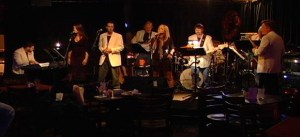
Basket Case
Basket Case at 3rd & Lindsley, Left to Rt: Steve King (keyboard); Holly Steele (background vocals); Rodney Ingle (background vocals); Tom Wild (guitar); Kristen McNamara (lead vocals); Bill Watson (bass guitar/bandleader); Tigar Bell (fiddle) ; John Heinrick, (sax). Background: David Northrup, (drums).
I received the first e-mail from songwriter Jon Smith back in my short hair days, 2005 I believe, saying he was disappointed with the work he’d received on his songs at several other Nashville studios and asking that 5 songs be produced for him at a budget far higher than any I’d experienced up to that point. The previous attempts to record his songs were interesting and the musicians competent, Jon said, but the music was flat, bland. There was no magic that he was sure was there.
We found it.
That initial e-mail led to multiple sessions totaling over 80 songs, a friendship, lots of rehearsals at S.I.R, and Soundcheck Nashville, a CD release, two videos and this live band that played Jon Smith tunes at venues in the greater Nashville area. What great fun it was!
Over the years of producing those sessions I used a lot of different top Nashville session players, excellent musicians all, but when Jon asked that a band be assembled so he could hear his songs performed live, I chose the ones I considered not just great musicians and singers, but also friends.
And my friends came through big time, the band sounded fantastic!
We initially resisted Jon’s suggestion that the male members wear white coats, but it turned out to be simply one more stroke of Jon genius. We only did a few gigs but quickly became known as “the white coat band” and it was memorable enough people still mention it occasionally, always referencing the white coats.
Here’s a swingin’ little tune that always made the setlist:
My Tears Are Puttin’ Out Your Fire is © 2007 Jon Smith. Co-writers: Jon Smith/Bill Watson, produced by Bill Watson. Used by permission.
That’s the studio version of MTAPOYF I produced in ’07 using mostly the same band pictured above.
Jon’s work was where I learned how to use horns effectively as opposed to creating a train wreck. Arranging, doubling, combining different horns together, stabs, swells, stacked horn tracks… if you have a tune you need sax, trumpet, clarinet or trombone on, or any combination of them, you’re at the right place! Send out an e-mail to nashtrax@bellsouth.net and ask for a quote!
I have the vids around of the band yet too and when I get around to it, will post some footage- b.e.

Left: David Northrup drums, Bill Watson Bass Guitar. No wonder the band was called Basket Case. Two prime examples for sure!
Songwriting Tip: Three Chord Groups
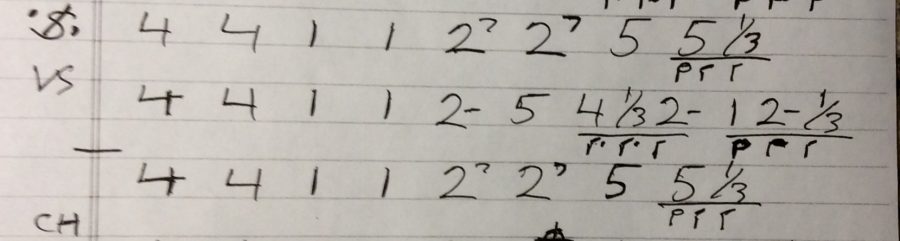
Posted: August 4, 2013 Filed under: Songwriting Tips | Tags: Bill Watson, Chord Chemistry Ted Greene, chord progressions, chord rules, chord substitution, guitar shop by bill watson, three chord groups, tonic dominant seventh Leave a comment
Knowing a few chords on guitar or piano is a good thing but some roughs I’ve reviewed here reveal that some newbie songwriters aren’t sure how to use them together. Sometimes chords are used that don’t support the melody or several chords are used that inadvertently introduce a new key in a spot where that shouldn’t happen.
Hopefully this post will reduce that confusion slightly, but in the larger sense, it’s aimed at introducing the abecedarian songwriter to the concept that there is a right way and wrong way to use chords, thus fueling the desire for further exploration of the principles.
Huh, abecedarian… pretty good word, eh? It means neophyte or beginner. Use it to replace a cuss word: “Listen, you abecedarian…” : )
As in most endeavors, there are rules. Rules can be broken but songwriters who don’t know the rules in the first place tend to break them in a bad way, in a way that detracts rather than enhances.
So here is a rule of sorts: Inject a sense of order in the writing process by employing a chord progression, which is several chords played in sequence that sound good together and firmly establish a key. There are many chord progressions that are accepted in music theory as “standards” and are used over and over, the simplest being the three chord group.
Many hit songs are written using only a three chord group, some with as few as two of the three chords in a group.
The easiest three chord groups to play on guitar are:
1. E, A, B7th
2. G, C, D7th
3. A, D, E 7th
4. C, F, G7th
5. D, G, A 7th
All of those can be played on guitar using open chords (chords that contain unfretted notes). The first chord in the three chord sequence is the tonic chord a.k.a. root chord. The second is the dominant chord, the third is the sub dominant or sub dominant seventh.
A three chord group is based on the major scale. Choose the 1st, 4th and 5th notes of a major scale and those notes name the three chord group for that scale with that 1st (the root note) naming the key. Also add a dominant 7th (7th) to the final chord (although the 7th is sometimes omitted).
For example, the notes in a C Major scale are:
C, D, E, F, G, A, B, (and back to C, up one octave in pitch from the original C).
The 1st, 4th and 5th notes of the C Major Scale, counting from C are C, F, G. So in the key of C, (C because the first note, the root note, is C) the 3 chord group is C, F, G. In the Nashville number system they’d be referred to as 1-4-5.
Click here to read the rest of this post, including how to use a three chord group to write a song and how to employ the principal of chord substitution.
Or you can skip the free stuff and go straight to the books this post is drawn from, we’re barely scratching the surface here. If you want to learn very basic open chord progressions and simple rhythms get my book Guitar Shop. If you want to learn more complicated chords, extended chords, how non-root bass notes work and learn all the chord substitution rules, get Ted’s book– bill watson
Update On Kerry McFate’s Clarence Lowden Album Project
Posted: July 7, 2013 Filed under: Client News, Client News, Pro Tools Software, Studio News | Tags: .wav, Bill Watson, Hank Williams Jr., Jamey Johnson, Johnny Cash, Kerry McFate, Mike Douchette On Pedal Steel, nashville trax, Taylor acoustic guitar, Wanda Vick on fiddle Leave a comment
Songwriter Kerry McFate (left) and producer Bill Watson (right) taking a break from mixing Kerry’s songs.
Songwriter Kerry McFate (left) and producer Bill Watson (right) take a break from mixing songs for Kerry’s Clarence Lowden album.
Kerry McFate will be taking his flight back to New York City tomorrow morning just thrilled with the experience at Nashville Trax and stoked about the way the songs came out.
“Bill, I’m blown away, I can’t thank you and your team enough for taking the songs I brought in, mere kernels really, and growing them into these fabulous recordings!” Kerry exclaimed as we parted.
He’ll be the first to admit he’s not a highly skilled singer technically, but he has a great voice and with do-over punch-ins, plus a little help from software, reverb, delay and EQ, his strong baritone, (which has shades of deep register country singers like Hank Williams Jr., Johnny Cash and Jamey Johnson) sounds just great, even better than he expected. He also played his own Taylor acoustic guitar and those tracks mixed in, no problem.
Fiddle and steel guitar are featured throughout, which Kerry requested when we first discussed the project, and sound super, thanks to the contributions of my favorite calls on both of those instruments, Wanda Vick on fiddle and Mike Douchette on pedal steel.
The mixes are finished on all three songs, which Kerry intends to release on CD under his fictitious Clarence Lowden name.
Kerry has the stereo mix .wav files as well as the (Pro Tools) session files on his hard drive. That’s actually the 8th or 9th copy of all files on 4 different drives because at Nashville Trax we meticulously back up on external hard drives in rotation at each stage of the recording process: After each song is tracked, after each overdub musician or singer completes their parts, and of course, after the final mix.
With these first few tunes I think we were able to define a direction and create a unique sound for Kerry that can be explored even further as the album is completed- b.e. watson
Why Nashville Trax?
Posted: July 7, 2013 Filed under: Studio Equipment | Tags: Bill Watson, Gretsch drum kit, Nashville session guitarist Tom Wild, nashville trax Leave a comment
Want great drum sounds? Come record where the great drum sounds are!
Nashville session guitarist, Tom Wild, mentioned how well the CD he produced in a couple previous tracking sessions at Nashville Trax (for one of his own clients) with yours truly engineering, turned out. (We cut the rhythm tracks and overdubs then exported them to Tom’s hard drive for him to mix.) He said his client was thrilled, the entire CD came out fantastic and promised to forward a copy.
The music was rock and Tom reported, “The drum sounds were just awesome and mixed great, don’t ever touch a thing.” Most Nashville studios either don’t own a drum kit or have a tiny, constrictive drum room with zero ambiance guaranteeing “dead on arrival” sounds that require a lot of signal processing to make them right, if they ever can be considering the typical “studio drum kit” is probably assembled from a bunch of used junk pro drummers didn’t want anymore. The huge drum room here with a permanently setup Gretch kit and microphones chosen specifically for each drum guarantee consistent sounds, The only adjustments I have to make most of the time are volume to account for drummers with a lighter touch and minor EQ tweaking to a specific type of music- Bill Watson
 A Songwriting & Recording Blog